Monday, September 23, 2013

Excerpts
From Shinto Shrines: A Guide to the Sacred Sites of Japan's Ancient Religion
Another post from the book relating to the architecture of shrines. As some readers may know, the vast majority of existing shrine buildings (as distinct from the founding of the shrine and what may or may not have been its original structure) were built between the sixteenth and nineteenth centuries. Most have been repaired or totally rebuilt but have managed to keep something close to the original style. The pitched roof is standard for all such buildings and very early on—perhaps as early as the seventh or eighth centuries—pent roofs were often added. While this is not yet a chidorihafu it is easy to see the evolution of the false dormer from the pitched roof - pent roof combination. The obviously separate pent roof—as in the Kasuga-zukuri style—evolved differently from what might be called the continuous-flowing combination of gable and pent roof known as a hip and gable (irimoya-zukuri) roof, which is more common. This combination was also prominent in both the shoin and shinden architectural styles. However it was probably not until the extensive building of castles got underway that the chidorihafu became a standard of any building attempting to express nobility or strength. While this sentiment may seem unrelated to shrines at first glance, it is important to remember that shrines were always built by the nobility. Therefore the aesthetic is closely connected and the chidorihafu became a standard of Shinto shrines and castles alike. Along with this, the slightly more decorative karahafu was used at an early date and can also be seen on castles from the sixteenth century. Though said to be from China (Jp. kara), this is not confirmed. It is often considered the more "noble" of the two and used more sparingly, for example, just over the main entrance. These two features do not apply to some specific shrine types, particularly as it concerns the honden. But even in these cases, the haiden (which may possibly have been constructed at a later date) is likely to contain chidorihafu and karahafu. As to chigi and katsuogi, many have been added after the Meiji period in an attempt to fall into line with the idea that Ise Jingu and its shinmei zukuri style, represented the "true" or most "elite" Shinto style. Here then is an excerpt from the book on a few of the common building characteristics of Shinto shrines.

Building Characteristics

Measurements: The traditional Japanese measurement system (shakkan-ho) came to Japan from China. The metric system was adopted in 1924 but the old system is still used in traditional building. Shrines are usually measured in bays (ken), with a bay being the distance between two columns. The actual measurement of one bay varies according to age, location, and custom. Excavations of Heian-period Kyoto show a bay having a span of 9.8 feet (from center to center of the pillar), whereas in the Edo period a bay measured about six feet-where it has remained to this day. The extremely large bays of Izumo Taisha measure about eighteen feet, but they are exceptional for shrines. The size of the bay may also vary within the same structure. The traditional Japanese length of measure is the shaku, which is 30.3 centimeters or about one foot. It is further divided in ten parts, called sun. Generally the standard is six shaku to a bay.

Wood construction: Japan is noted for its Hinoki Cypress(Chamaecyparis obtusa), which have provided most of the wood for both shrine and temple construction over the centuries. The structures all use post-and-lintel construction with cut and fitted joints. The use of nails or glue is limited. Some shrine types have the main pillars planted directly in the ground. Most shrines since the eighth century have pillars resting on stone bases, as do Buddhist temples. Infill walls may be wooden board or clay and plaster over bamboo lath.

Periodic rebuilding: Shikinen sengu means a periodic rebuilding of the shrine. The period is often fixed at twenty or twenty-one years, but it varies by shrine. The reasons for the rebuilding are ritual renewal to maintain purity; the natural deterioration of wood construction (especially where pillars are planted directly in the ground); and the need to train new carpenters in the ancient building techniques before the older carpenters die off (however, temples did not follow the custom, which seems to lend weight to reasons of ritual purity). The most famous such rebuilding is that of Ise Jingu, the preeminent shrine of Japan. Though many shrines that once underwent this renewal process are currently designated Important Cultural Properties and are only repaired, not rebuilt., Ise Jingu still observes a twenty-year rebuilding cycle. It has been carried out since the seventh century, uninterrupted except for a hundred-year interval between the fifteenth and sixteenth centuries. Some of the 125 structures at Ise are rebuilt at twenty-year intervals, while others are rebuilt every forty years or as need be.

Painted or unpainted: It is widely thought that shrines are made in unfinished wood and temples are painted, but this is incorrect. Both can be found in unfinished or polychromed wood. Where paint is used, a vermillion or cinnabar red generally predominates. Toshogu shrines tend to have the most ornate polychroming. Certain types of shrine building are never painted (and probably never were). Shinmei- and taisha-zukuri are two such styles. Others, such as Toshogu, Sumiyoshi, and Kasuga, are always painted (please see the descriptions of these styles below).

Roof types: There are several roof types, surfaced in one of a number of materials: straw; kaya (miscanthus); cypress bark; cedar or other wood shingle; copper shingle; copper tile; and at a later date ceramic tile. (Tile is used primarily in temple construction.) Roofs are always gabled, and one of the most common types is the irimoya-zukuri (hip-and-gable style). The other common style is called nagare-zukuri and is essentially an asymmetrical gable, with one side extended to cover the stairway on the entrance (front) side. The other primary type is the yatsumune roof found on buildings that combine the honden and haiden in one (see below).
Chidorihafu and karahafu
Key features: False A-shaped dormers called chidorihafu are a common feature on shrines, especially on the haiden from the sixteenth century onward. They are generally featured on the front side, in the center of the roof. Below them is often found a curved-bargeboard roof feature called a karahafu. It is usually on the edge of the roof directly over the entrance, or on an extended roof canopy overhanging the stairs (kohai). It is also a key feature of elaborate gates and the extensive use of both types give Japanese castles their distinctive appearance. Other key features include pent roofs, verandas, and bracket sets supporting the roof eaves and veranda.
Chigi and katsuogi


Chigi and katsuogi: These are the most distinctive markings of Shinto shrines, though they only appear on some building types. Chigi are forked finials supporting the ridge board and extending past the ridge to form a V shape above the roofline, or sitting on the ridge to form an X shape. They are thought to be the remnants of the roof brace poles that were lashed together with rope in ancient construction styles. Today they are usually symbolic additions that sit on top of the roof ridge at each end. The direction of the cut at the end of the chigi may indicate the presence of a male or female kami-a vertical cut indicating a male, and a horizontal cut indicating a female. Katsuogi are log-like forms that sit on top of the roof ridge, perpendicular to it; they usually number five or six, but there may be as few as two or as many as twelve. The katsuogi (so named because they resemble dried katsuo bonito) once served to help weigh down the ridge and hold the straw roof in place. But at least by the fifth century, they also became decorative elements adorning the emperor's palace, according to an entry in the Kojiki relating to Emperor Yuryaku (r. 456-79). As early as the sixth century, the right to erect chigi and katsuogi was extended to include the homes of powerful families. Today both katsuogi and chigi are used to adorn certain types of shrine buildings, especially those in the shinmei, taisha, Sumiyoshi, and Kasuga styles.
Tomoe

Emblems: Most shrines sport a crest that is a representation of either the enshrined kami, the clan that founded the shrine, or the shrine's status. They are generally round marks with some type of pattern within, such as the hollyhock of the Kamo shrines, the yatagarasu three-legged crow of the Kumano shrines, or the chrysanthemum of shrines associated with the imperial court. An emblem common to many shrines is the mitsu tomoe representing the division of heaven, earth and man.

Sunday, September 15, 2013

Susano-o

The "Dark Brother" of Amatarasu; Susano-o no mikoto 
and the traditions of Izumo Taisha
Susano-o by Kuniyoshi
(courtesy of Wikipedia)
While 2013 is most significant in the world of Shinto for the twenty-year rebuilding (shikinen sengu) of Ise Jingu, the second most significant event may be the sixty-year refurbishing of Izumo Taisha in Shimane Prefecture. I have gone into some detail about this impressive shrine in Shinto Shrines; A Guide to the Sacred Sites of Japan's Ancient Religion. Here I will summarize some of the research that relates to the shrine and its deities. As readers of the book and this blog are probably aware, Izumo Taisha enshrines Okuninushi no okami who is the son (or sixth-generation ancestor depending on the source) of Susano-o. The latter deity is said to be the brother of Amaterasu omikami of Ise Jingu, and is portrayed as the "dark force" to Amaterasu's "light force" in the Kojiki and Nihon shoki. Though never couched in quite those terms, the story is the quintessential "good guys vs. bad guys" scenario. As you might expect, the "bad guy" is in many ways the more complex and more interesting of the two. His ancestor, Okuninushi, is also a very interesting and significant kami and may even represent the influence and contribution to Japanese culture made by peoples form the Asian mainland—especially those from the ancient kingdoms of Korea. Hopefully I will have a chance to recount some of the more interesting research related to Okuninushi in future entries. For this entry, however, I want to concentrate on Susano-o. Though he is not the deity of Izumo Taisha as I mentioned above, he embodies the spirit of independence of the region as well as reveling some of the character of the early Yamato polity by the way it represented its opposition.

Izumo as the 'Other Japan': Construction vs. Reality
by Klaus Antoni
This first piece is a sort of overview of the issues related to Izumo and its position in the history and mythology of Japan. The paper focuses on the ancient and the Meiji era history and how these became intertwined to create the image of Izumo as an "exotic other" which tries to both be and not be a part of the Emperor-centric shinto mythology. The secondary focus of this article, as with so much of the discussion of Shinto (or of any faith) is how much effort—if any—should be put into trying to relate myth to actual history. The author discusses this issue in relation to the actual historical ties between the Izumo region and the ancient Korean kingdom of Silla (jp. shiragi) vs. the mythology in the Izumo fudoki, as well as the romantic writings of Lafcadio Hern who introduced a "dreamlike" Izumo to the world in his recounting of myths and fables vs the reality of late ninteenth century JapanY.
Antoni begins with a look back at the history of Izumo from the death of the 83rd guji of Izumo Taisha and kuni no miyatsuko of Izumo, Senge Takatoshi. In recounting the traditional independence of Izumo, he explains the position of kuni no miyatsko and its pre-Taika reform status and how the Senge clung to this now purely ceremonial status into the modern age. He then introduces the ninth-century Izumo Fudoki which recounts the mythology of the region from the point of view of the people who lived there. It may be recalled that the fudoki was a report made to the Yamato government by individual regions, recording their myths and deities and significant events. These were in-turn used to augment the official mythology that was compiled into the Nihon shoki. Antoni makes clear some of the differences between the official mythology and the original. In the original Izumo mythology, the most important myth is the "land-pulling" myth (kunihiki) which recounts how the main deity of Izumo, Yatsukamizu omitsuno no mikoto pulls several chunks of land from the kingdom of Silla and adds them on to the land of Izumo to enlarge it. Both this deity and this story are missing from the official mythology. On the other hand, Susano-o, a benign agricultural deity of the region, is given central position as the errant brother of the sun goddess, who tries to overturn the rule of heaven and gets his comeuppance in the end. But the real influence of this tail on later—and especially the Meiji—generations, is in the position of Susano-o's son, Okuninushi. Okuninushi is portrayed in the official mythology as the deity who surrendered the land to the rule of the heavenly grandson in return for being worshipped at Izumo Taisha and for being given domain over the invisible world which includes the soul after death. Much of the development of this idea is credited to late-Edo period scholar Hirata Atsutane. It is in this capacity, it was argued in early-Meiji, that Okuninushi and Izumo should be ranked equal to Amaterasu and Ise Jingu. Lafcadio Hearn who lived in Izumo during this time, did much to spread the image of the region as a "cultural heartland" of the very ancient and pure Japan that the Meiji oligarchs tried so hard to promote—but in relation to the Emperor and Ise. This conflict between history and myth, especially as it plays out in the ancient conflict between Izumo vs Yamato, Korea vs Japan, archaeological and textural evidence vs modern constructs, sets the background for the ongoing discussion of the significance of the Izumo region and its mythology.
Online at http://japanese-religions.jp/publications/assets/JR30_a_Antoni.pdf

Detail of Yamata no Orochi
by Toyohara Chikanobu
Susanoo: One of the Central Gods in Japanese Mythology  (21 September 2013)
by Emilia Gadeleva
This paper focuses on Susano-o and its premise is that the deity was one of rain/water/agriculture which by its very nature contained both positive and negative aspects. The concept is also put forth that the imperial myths which were transformed and codified in the eighth century were based on much older beliefs. In other words, the author disputes the idea that assignment of negative characteristics to this deity was purely politically motivated and instead sees the primary pairing of a rain and sun god (Susano-o and Amaterasu) as a natural consequence of an agriculturally based society (near the conclusion of the paper, the author points out how this important pair could also be characterized as a benign and predictable sun vs an unpredictable and sometimes destructive rain). Her conclusions are the result of textural studies of the five remaining fudoki as well as the Kojiki and Nihon shoki. She also reviews the opinions of a number of Japanese scholars who see Susano-o as everything from a deity of the underworld, to a political foil for the consolidation of the Amaterasu-centric Yamato state, to a benign agricultural deity, to a deity of forests and shipbuilders, to a deity worshipped by Korean immigrants.
Susano-o mythology is looked at from the point of view of four phases: beginning with the character of Susano-o as a young boy, his constant crying and causing of disasters in his desire to go to "the land of his mother" (ne no kuni) is highlighted. Then, as a young man, his exuberance and violence is highlighted and a parallel is drawn with Yamato Takeru—that other violent hero of Japanese mythology. Next comes his transformation from bad actor to hero and benefactor when he slays the goddess of grains (an act of destruction which results in the positive birth of the five-grains), slays a dragon and saves a maiden. Finally, the paper takes a look at his role as lord of the neither world and father of Okuninushi. Along the way his negative image is highlighted as the result of two atributes; his reckless exuberance (unintentional "badness") and his rivalry with his sister, Amaterasu (more intentionally bad). While his positive image is related to his slaying of the dragon in Izumo (water and the image of dragons is closely related in ancient custom) and either his slaying of the food goddess (Kojiki) or his planting of trees (Nihon shoki). As to Susano-o's depiction in the fudoki, the author first refers to the fudoki of Bungo (present day Oita prefecture in Kyushu) where Susano-o is identified with the deity of the northern seas called Muto. He is depicted in a story where he is considered a god of the sea who brings calamities upon those who do not respect him, and he is considered a foreign god (banshin). However, in relation to Susano-o it is the Izumo fudoki which is of prime importance. Here the author looks for the roots of the name itself and its connection to rice and agriculture. In reference to one myth recorded here the author points out the mention of the deity of Kumano Shrine, a prominent shrine in both Izumo and Kumano in the Kii Peninsula. The importance of this god was said to have determined the roles of the hereditary worker groups (be) in relation to their religious duties, and that one of these was responsibility for offering clean food and water to the gods. The deity worshipped at both Kumano shrines is Susano-o—again tying this deity to agriculture, water and the cleanliness of food (Susano-o's reason for killing the food goddess is the unclean way in which she offered him food). Later on, the author relates the name Kumano to the ancient word kuma meaning "rice offered to the gods." Through the connection with Kumano Shrines as well as with numerous references to Korea (including the possibility that the name Susano-o is related to the Korean word susung meaning "shamen") in the myths relating to Susano-o, the author concludes that Susano-o was originally modeled on the priesthood which was responsible for food offerings and for predicting the amount and timing of rainfall. The latter responsibility exposed the shamen to criticism and blame when too little or too much rainfall was forthcoming—hence the image of the god as destructive. Perhaps also because of the relation of the location of the Kumano Shrines at what was believed to be the entrance and exit to ne no kuni (the neither world or more literally "land of roots"), Susano-o came to be seen as the ruler of the ne no kuni. Though not originally considered a negative place but one of rebirth and revitalization, ne no kuni eventually became associated with yomi no kuni, the place of death and pollution. This too contributed to the negative image of this important and complex deity. Interesting and detailed research.
Online at http://shikon.nichibun.ac.jp/dspace/bitstream/123456789/1446/1/IJ1209.pdf

Susano-o slaying the dragon
by Kuniteru
The Land-Pulling Myth and Some Aspects of Historic Reality (22 September 2013)
by Anders Carlquvist
This paper focuses on an important aspect of Izumo mythology as mentioned in the previous paper: The Land-Pulling Myth. The author seeks the true significance of this important myth, from the Izumo Fudoki, in aspects of recorded history. The author begins by recounting the myth while annotating its four chapters which refer to four different pieces of land that were "pulled" and "attached" to the Land of Izumo by the deity called Yatsukamizu Omitsuno. That land includes; Kidzuki Cape, pulled from Silla in Korea; Sada. pulled from Sakai Country; Kurami, pulled from Yonami Country; and Miho, pulled from Tsutsu Cape in Koshi. The exploration for meaning begins with looking at similar myths from other counttries. The author finds numerous references in Asia to new land being dredged up from the sea but finds nothing like the "cutting" of land that appears in this myth. The author looks as far afield as Scandinavia and finds some compelling similarities but concludes that the connection is tenuous. In support of the theory that the land-pulling myth represents the "countries" allied to form the socio-political-economic Izumo Alliance, the author extensively outlines the number and size of kofun (burial mounds of the late Yayoi period)  in the area and their possible relation to the relative strength of the areas mentioned in the myth. Though the fudoki was compiled at a much later period, the author argues that elements of the ancient power centers survived. While recounting the writers of the Izumo Fudoki and their position—especially that of kuni no miyatsuko—the author goes on to explain some of the key differences in the interpretation of the fudoki and the kiki* of deities who were central to the Land-ceding myth. The Land-ceding myth explains how the heavenly ancestor of the imperial house, came to be the ruler of the land of Japan by gaining suzerainty over the land of Izumo. These differences reflect the way hat Izumo and Yamato viewed their positions. Finally, the author recounts a second prominent myth from Izumo fudoki that of the wani—and uses this as part of his argument that the real purpose of the Izumo fudoki was to assert the rights of the kuni no miyatsuko and emphasize the willingness of the region to protect itself from encroachment by the Yamato state. The inclusion of a strong relation to the Korean kingdom of Silla and the area of Koshi—both of which which had previously fought and won a major battle with the Yamato state—serves also as a warning to treat Izumo as a docile, yet dangerous, ally. Thus the author concludes that the significance of the land-pulling myth is defensive and political.
* the Kojiki and Nihon shoki

Online at http://nirc.nanzan-u.ac.jp/nfile/3016

The Kusanagi Sword (October 26, 2013)
by Nelly Naumann
This paper focuses on one of the three symbols of power, known as the "Three Regalia" (sanshu no jingi), associated with the accession of the emperor. The three are the Yata no kagami (mirror), Yasakani no magatama (jewel) and the Kusanagi no tsurugi (sword). Although a symbol of power of the emperor, the Kojiki and Nihon shoki relate that the sword had its origins in Izumo. The sword is kept at Atsuta Jingu in Nagaoya and this paper follows the origins and mythology attached to it.
Much uncertainty surrounds all the regalia including whether or not the current objects are copies of the originals or copies of copies, and of what provenience. The Nihon shoki recounts that when Emperor Sujin became fearful of the power of the two kami (Yamato no okunitama and Amaterasu) as embodied in the sword and mirror, he sent them out of the palace. The mirror went to Ise and the sword was enshrined at "Anashi in Yamato" and later put under the care of the Yamato no Atae and finally sent to Ise. How it is that the sword resides at Atsuta Jingu is part of one of several lines of mythology which this paper attempts to follow. The first line, which Naumann describes as essentially political in nature, has us follow the discovery of the sword by Susano-o in the tail of the eight-headed serpent which he kills on his arrival in Izumo. He then sends it to his sister Amaterasu as a token of sincere apology (servitude?) and she bestows it upon her nephew Ninigi when he descends to rule the land (hence its role in imperial succession). Many generations later the sword is given for protection to Yamato-takeru by his aunt the saigu of Ise Jingu, while he is on his way to subdue the tribes of the East. Before his last mission, he leaves the sword with his wife, a daughter of the Wohari clan, and she enshrines it at Atsuta Jingu after he is killed.
   The second important line is the more natural one; the sword stays in the family of Susano-o and resides in Izumo. This line is supported by the sojourn of Susano-o's son Okuninushi to the underworld to visit his father. He is assisted in overcoming the trails through which his father puts him by Suseri-bime with who he flees, taking with him the sword of life, the bow-and-arrows of life, and the talking zither, with which he will rule the land. In this line, Susano-o naturally bestows three regalia on his own son who is to be the new ruler of the land and the serpent symbolism is seen as one of new life generated from death. 
   But there is a third line which posits that the sword always belonged to the Wohari clan and may only have been lent to Tenmu, who saw to it that it figured prominently in the royal succession. This theory takes its support from two directions. First, the implausibility and convoluted stories relating to how the sword was visited upon the emperor and how it came to reside at Atsuta. Second, is the historical relationship between the house of Wohari and that of the imperial family. Beside the fact that the Wohari saved Tenmu's bacon so-to-speak in his war against his brother's son to gain the throne, the author points out that the Wohari traced their family back to the third son of Ninigi and were therefore of the same lineage as the emperor. A Wohari consort of Emperor Keitai bore two sons who became Emperor Ankan and Emperor Senka. Only the entries for Keitai and Senka in the Nihon Shoki record accession rites involving the Kusanagi sword. There is also the curious recorded incident of the monk Dogyo stealing the sword in the year 688 and making for Korea. Inclement weather forced the monk to return and the sword was kept in the palace for eighteen years before being sent (returned?) to Atsuta after it was deemed to be the cause of Emperor Tenmu's illness. Naumann concludes that the third line is the most plausible with the qualification that the sword most likely did originate in Izumo and may have been a sign of that countries subordination to Yamato and of Yamato's early reliance on the clans of its eastern-most territories.
Online at http://www.freidok.unifreiburg.de/volltexte/4635/pdf/Naumann_The_kusanagi_sword.pd 

The Susano-o character from an RPG game


Sakahagi: The "Reverse Flaying" of the Heavenly Piebald Horse (20 March 2014)
by Nelly Nauman
I am finally getting around to the last of these papers dealing with the "dark brother" of Amaterasu, Susano-o. It is another paper by the great German ethnologist and folklorist, Nelly Nauman. Here she focuses on an aspect of the mythology of the wild and rude behavior of Susano-o; the "Reverse Flaying" of a piebald horse. Briefly, after Susano-o and Amaterasu have a contest to see who can produce the best children, Susano-o declares himself the winner and proceeds to revel in his victory resulting in all manner of "sins" such as defiling the heavenly rice fields and the hall of the tasting of first fruits. All this is forgiven but when he "reverse flays" a piebald horse and dumps it through a hole in the ceiling of the sacred weaving hall, he frightens the weaving maiden (or Amaterasu herself) who strikes herself in the genitals with the shuttle and dies. This causes Amaterasu to hide herself away which causes the world to go dark. Nauman says that most studies of the myth gloss over this event as just one more in a series of misdeeds by Susano-o. But Nauman delves further to try to uncover the deeper meaning behind this "final straw". She begins with the concept of "reverse flaying" which she associates with other types of reverse actions such as reverse clapping and reverse drinking which are mentioned elsewhere in Japanese mythology. It seems that the very action of reversing what are normally life affirming actions are considered a cause of death. In this case, we have the death of the weaving maiden or indeed of Amaterasu herself who then "hides away" in a cave sealed with a huge stone in the same way that kofun tombs were used to bury the dead. She also goes into a detailed explanation of how the opposite action (the putting on of a new skin) can symbolize the attainment of new life. Through another series of myths, especially Chinese,  she relates the piebald horse to the moon and also explains how it was probably a cultic figure in Japan. She then interprets the dropping of the reverse-flayed piebold skin into the weaving house as the death of the moon (represented by the horse) and the killing of the light (represented by the weaving maiden). His punishment, besides banishment from heaven, is to have his nails and his hair pulled out. This is seen as a kind of exorcism and purification allowing him to transform into a giver of and protector of life as is seen by his subsequent actions on earth. As this disappearance of the light is followed by another disappearance (that of Amaterasu into the cave) Nauman fells that these are similar myths from two different cultures (Izumo and Yamato) mixed together because of their similarities. Such mixing of myths and the grafting of contemporary (i.e eighth century myths) onto late Jomon and Yayoi myths (weaving was likely introduced in the very late Jomon or early Yayoi) is what makes Japanese mythology so difficult to decipher. Nauman shows us again how the coincidence of imagery can lead us astray while a broader and deeper search for meaning enriches our understanding.
Online at http://nirc.nanzan-u.ac.jp/nfile/1155

Wednesday, June 26, 2013

Mount Fuji

Mount Fuji and its Religious Traditions
Fuji Sengen Mandala
(photo courtesy of
Fujisan Hongu Sengen Taisha)
In honor of the inclusion of Mt. Fuji in the list of World Heritage properties, I am posting summaries of some scholarly papers related to its religious traditions. This will be along the lines of the posting on Amaterasu omikami and the origins of Ise Jingu.

In Shinto Shrines; A Guide to the Sacred Sites of Japan's Ancient Religion, I have included an eight-page entry on Fujisan Hongen Sengen Taisha, which literally owns the top of Mt. Fuji, as well as a number of shrines around the base of the mountain that figure in its history. While guide books and advice on climbing the mountain or lodging nearby abound, here I will review some English-language sources relating to the sacred history of the mountain. Of course, everyone in Japan knows Mt. Fuji and perhaps even a majority of the people consider it the preeminent symbol of the country, yet few are familiar with even the broadest outlines of its sacred history.

Finally, for those who would rather climb Mt. Fuji than read about it, I am happy to present this piece by American Shinto priest, Pat Ormsby, which comes to us via good friend John Dougill's Green Shinto blog. The original piece is here: http://www.greenshinto.com/wp/2013/03/31/fuji-seven-sacred-trails/ and I highly recommend the blog for anyone interested in Shinto or in various aspects of Japanese culture. Several other pieces by Pat Ormsby are posted there as well.

While you're here, any readers who are interested in having a kamidana of their own, or would like to send one to a friend or family member, please check out this post: https://shintoshrinesofjapanblogguide.blogspot.com/2019/06/portable-kamidana-jinja.html

Fuji: Seven Sacred Trails  (11 July 2013)
Reconnecting with the sacred paths of Mt. Fuji
by Patricia Ormsby
Mt. Fuji has been worshiped as a divine entity from as far back as anyone was keeping record, with pilgrimages undertaken to the summit in ancient times.  These days paved roads can take you half way up the steep slopes, and the climb from there is more popular than ever, but the old pilgrimage routes around the base and up the lower slopes have been all but forgotten.  There is not much of a view from the dense forests, and it takes real devotion to put in the long, hot climb required.  The ancient routes are nonetheless notable.

The Yoshida Trail According to the City of Fuji-Yoshida, “The original Yoshida Climbing Route starts from the Fuji Sengen Shrine, where the pilgrims of over 500 years ago came to pray before they started their climb up the sacred mountain.  Today, traditionalists still claim that the only way to climb Mt. Fuji is from the Fuji Sengen Shrine.”  This was the most easily accessed route from Edo, where the devotional Fuji confraternities (more on them later) were very popular during the Tokugawa rule.  Since it is the route of a marathon to the summit each July, it is the best maintained of all the hiking trails below the 5th Station.

The Murayama Route The Murayama Route is the oldest trail up Mt. Fuji, followed by the nearby Suyama Route.  It was developed about 1000 years ago together with a temple complex in the village of Murayama, just south of the volcano, which became a lively center of ascetic Shugendo practice.  The trail fell into disuse in 1903, but has been revived in recent years.  Several years ago, I attempted to follow the Murayama Route, but got lost when it entered a summer home community which had well developed recreational paths heading off in all directions, obscuring the ancient route.  Since then, however, more efforts to reestablish the trail have been made, and two years ago, accompanied by two Shugendo practitioners, I was able follow the entire route from the Murayama Sengen Shrine. The route was well marked, with a few obstacles. At the 5th Station parking lot, it joins the crowded Fujinomiya Trail to the summit.  My companions, in full yamabushi (mountain ascetic) regalia, were delayed several hours on the latter by hikers wanting them to pose for pictures.  Dedicated practitioners start their pilgrimage from the port of Tagonoura in Fuji City.  Their journey has three sections, the first of which is the urban-suburban roadways of what once was a grassy plain, and represented “this world.”  The forests of the Murayama Route represented a transition, and the bare slopes higher up, the world of the dead, to which the pilgrim could go and return.

The Suyama Route Similar to the Murayama Route, the Suyama Route has recently been rescued from oblivion.  It starts from the Suyama Sengen Shrine near Ashitakyama, an eroded volcanic remnant southeast of Mt. Fuji.  Its lower reaches pass adjacent to a golf course and other tourist facilities that lend it a certain quantity of litter and noise, but it is geologically interesting.   Mizutsuka, one of several old cinder cones along the way, is one of the few places on the mountain with reliable surface water.  The trail gives views of all three of the Hoei-zan craters, site of Mt. Fuji’s most recent eruption in 1707, before reaching the Ochuudoh and Fujinomiya Trails at the 6th Station.The Gotemba Route, which parallels it nearby, is the most difficult and picturesque route up Mt. Fuji, climbing through cinders from the Hoei eruption, but the trail appears to have no deep history.

The Subashiri Trail From the vicinity of the Niihashi Sengen Shrine, established about 800 years ago in Gotemba, east of Mt. Fuji, there is a trail going up to the small secondary peak of Kofuji near the Subashiri 5th Station.  I can find nothing on the history of that trail, but have heard that in old times women were allowed access to a smaller peak on pilgrimages, and I have long thought that peak might be it. The main Subashiri Trail currently rises from the 5th Station and meets the Yoshida Trail at the 8th Station.  This causes confusion among hikers attempting to descend on the latter.  If the Ochuudoh route were better known, it would be a cinch for lost hikers to return to the proper trail at the 6th Station, taking about twenty minutes along a level course.

The Shoji Trail The Shoji Trail is one of the most interesting routes, leading from Lake Shoji to the northwest of the mountain to the 5th Station, where it joins the Ochuudoh and Yoshida Trails.  There is no shrine associated with it, and it bisects the haunted forest of Aokigahara, where families once abandoned their elderly to die, currently a destination for suicides. Compasses often do not work in the forest due to geomagnetic anomalies.  This is a shame, because otherwise, it is a most impressive route.  Devotees piled up basalt rocks to make the route smooth and straight, and the dense forest has largely protected their work from erosion. The road was broad enough to accommodate royalty and is still easily passable, despite fallen trees, and unmistakable for its entire course.  The minimal signs are more than adequate.  The two yamabushi and I hiked down it at night.  This trail and the Ochuudoh provide a sense of the degree of devotion once shown by pilgrims, ascetic practitioners and lay followers alike.

The Ochuudoh Literally, “the middle road,” this route circumscribes Mt. Fuji at the 5th to 6th Stations and was particularly beloved by the Fuji confraternity, who maintained at least one shrine along it which also provided lodging.  Representing the Buddhist injunction to avoid extremes, it was nonetheless the most difficult pilgrimage route, with a hazardous crossing of the Ohsawa Kuzure, an erosional gully on the west slope. The route fell out of use several decades ago when the gully became simply too dangerous to cross, but I have traveled nearly all of it and was able to ascertain its current status last October.  The entire route on the Yamanashi (i.e., north) side is in good condition, passing through forests which protect it from rock slides.  Parts of it near the Yoshida 5th Station parking lot have been paved with hand-hewn stones, presenting a broad, currently popular route.  Like the Yellow-Brick Road, however, things get wild further on and care must be taken to stay on course. The Fuji confraternity shrine is just short of the constantly rumbling chasm of the Ohsawa Kuzure in a dense foggy forest about 1.5 hours walk westward from the Yoshida 5th Station parking lot.  Eastward, just short of where it intersects the Subashiri Trail, there are the remains of another shrine.  Crossing over to the Shizuoka (i.e., south) side from there, however, the trail emerges onto bare slopes, where it was annually obliterated even when it had large numbers of travelers. A sandy slog of about an hour, angling slightly upward takes you into view of the Hoei-zan crater, where the Ochuudoh is clearly marked and well traveled, running along the shoulder of the cinder cone, then descending into the crater, emerging at the Fujinomiya Trail 6th Station.  Westward from there, however, it has been entirely obliterated by bulldozer roads, and its point of reentry into the forests beyond can be hard to locate.  There is at least one brave soul, however, who makes the complete circuit regularly, descending to the base of Mt. Fuji to cross the Ohsawa Kuzure, and climbing again on the other side as a summertime exercise when his real passion of cross-country skiing is not possible.

Eight Inner and Eight Outer Lakes The Fuji confraternity was a sect founded in the early 16th century by Hasegawa Kakugyo, an ascetic who bypassed the thriving Shugendo community at Murayama and undertook his own ascetic practice in the Hitoana lava cave to the west of Mt. Fuji.  Highly popular as a lay organization promoting Fuji pilgrimages during the Edo period, it seems to have been bypassed by modernity, the most recent Hasegawa heir shunning the leadership. The remaining members are mostly old enough to remember the deprivations of World War II or its aftermath. Their liturgy mentions “uchisoto hakko no ryuujin,” meaning the dragon gods of the eight inner and eight outer lakes.  The inner lakes include the famous five lakes of Mt. Fuji and three other smaller lakes that are not famous.  The first of these is Lake Osensui, where the Dragon King of hand washing is said to reside.  That is the ritual of purification undertaken before entering sacred ground.  The second is Lake Yamanaka, where dwells the Dragon King of medicine.  The third is Lake Asumi, with the Dragon King of prophecies.  The fourth is Lake Kawaguchi, with the Dragon King of irrigation.  The fifth is Lake Saiko, with the Dragon King of green trees (that is to say, the haunted forest of Aokigahara), from where arise the seeds of our food.  The sixth is Lake Shoji, with the Dragon King of success.  The seventh is Lake Motosu, with the Dragon King of ancient origins from the mists of mythology.  The eighth is Lake Shibire, with the Dragon King of future outcomes. The Fuji sect followers still undertake pilgrimages to these, but travel by car. The Tokai Shizen Hodo, established in recent decades from Tokyo to Osaka, passes fairly close to most of the lakes, making a pleasant trip on foot possible. It would be less strenuous than climbing Mt. Fuji—unless one undertook the traditional ritual bathing at each lake. Fed by Mt. Fuji spring water arising from deep below the surface, they are icy cold. The eight outer lakes include Biwako, Ashinoko, Futamigaura, Suwako, Chuzenjiko, Harunako, Sakuragaike, and Kasumigaura.  Of these, Futamigaura is not actually a lake but a sea coast in Ise. However, it shares with the others the distant visibility of Mt. Fuji, if not directly, then from a mountain nearby. At Futamigaura, which has the famous married rocks joined by a rope of rice straw, the sun rises from directly behind Mt. Fuji at the summer solstice.  Visiting all of these would have been a labor of great devotion in times prior to modern transport.

Asama Jinja in Studies in Shinto and Shrines (6 July 2013)
by R.A.B. Ponsonby-Fane
Less well-known than Chamberlin, Sansom, et al., Ponsonby-Fane wrote extensively on the history of Shinto shrines and their deities in the 1920's and 30's. In his entry for Asama Jinja (Fuji Hongu Sengen Taisha) he begins with the story of the deity of the shrine as it was known at that time, Konohanasakuya-hime, as related in the Kojiki and Nihon shoki. He provides some detail about her father, Oyamatsumi, a deity which makes a number of unrelated appearances in the kiki but which seems to be simply a mountain deity. He then goes into the problem of how Konohanasakuya became the deity of the mountain, considering only that she was supposed to have been a deity of great beauty and the Fuji was regarded as the same. He then goes into the foundations of the shrine which according to tradition, was founded in Yamamiya and moved to its present site in Omiya (now Fujimiya) in 806, displacing a Fuji Jinja mentioned in the engishiki which is now a sessha of Fuji Sengen. In terms of the shrine building itself, he says that the first mention is in Azuma Kagami under the date 1223. The shrine burned during the Onin Wars and was rebuilt around 1578 but burned down again and the present incarnation was rebuilt by Tokugawa Ieyasu in the early 1600's. He then goes into great detail about the shrine buildings. In the next section on sessha and massha, he revisits the Fuji Jinja which is thought to be from the reign of Emperor Korei (legendary emperor whose reign is traditionally dated as 290-215 B.C.). He says that the deity of this shrine is Fuji Tayu  also identified as Oyamatsumi. He also relates an interesting story of how Mt. Fuji got its snow from the Hitachi fudoki. (Paraphrased) "In the old days, Miyoya no kami made the rounds of the abodes of deities and it was night when he came to Suruga where he wished to stay the night. The Fukuji no kami refused him saying that it was a festival day and the house was fasting. At this the Miyoya no kami became angry and said, You! why do you refuse your father? The mountain on which you dwell shall be covered  in snow winter and summer and there will be nothing to eat or drink." He mentions that Asama Jinja owns the top of the mountain above the 8th station but does not go into detail (for more on this, please see my book Shinto Shrines). The entry ends with some details of the priestly family of the shrine and some mention of its Buddhist history (which he refers to as a "contamination") before ending with some notes on the shrine's festivals. Ponsonby-Fane was a royalist and staunch supporter of the Emperor and as such, his research is somewhat tainted. Still, he relates interesting details that speak of the depth of his research.
Available from booksellers, published by Routledge which is happy to provide it to you, complete with a binding that falls apart inside of six months, for the meager price of USD 199.54 

The Formation of Emperor Worship in the New Religions—The Case of Fujido (6 July 2013)
by Miyazaki Fumiko
Despite the focus of this paper on the relation between emperor worship and the formation of the new religions of the late-Edo and early-Meiji periods in general, it gives a good understanding of how worship of Mt. Fuji underwent the change from shugendo and combinatory religion, to a "purely" Shinto-based faith. By the early nineteenth century, Fujido had become the largest of the Mt. Fuji fraternities (know as ko), which were derived from the followers of Kakugyo's and Jikigyo Miroku's teachings. These teachings were that everything was derived from the original father and mother which was also considered to be the sun and the moon. Believers were urged to apply their energies to peace and fertility, diligence in the family occupation and matrimonial harmony—in other words, the basic Confucian values of the Tokugawa era. Where they differed from these values was their stress on the equality of the social classes (warriors, farmers, artisans and tradesmen) and the equality of the sexes. In a time of much strife, Fujido was also one of a number of millenist or "world renewal" movements (such as the "ee ja nai ka", this one focused on the coming of the age of Miroku (Maitreya). While the motivation for many of the Japanese new religions is well known (the social upheavals, coming of Westerners, and the Meiji ban on mixing religions), Miyazaki examines the mechanism by which this change took place in the Fujido. In short, the pressure from the Meiji government to conform to its new standards for religion caused most cults to either close down or to totally revise their doctrines and rituals. While Fujido chose the latter, even changing the name of the organization to Jikkokyo and becoming one of the thirteen authorized Shinto cults. The transition was made by the ninth successor, Gyoga, and Shibara Hanamori who was influenced by the theories of Hirata Atsutane. As an example of how Fujido's views became transformed, Miyazaki talks about their view of history. They believed that for the first 6,000 years of human history, the world was governed by the original father and mother. For the next 12,000 years (the "Age of the Gods") rule was in the hands of Amaterasu omikami (as the child of the sun and the moon). The next 30,000 years were (and this had already begun, in their view) the Age of Miroku. In affecting the adoption of a new Shinto based on the divinity of the Emperor, one important point was the emphasis on "pure Japanese" (i.e. untainted by Chinese [Confucian] or Indian [Buddhist] culture) which existed in both Fujido and the new National Learning. This resulted from the prevailing "commoner (Fujido member) vs. the elite (Confucian-intellectual, Buddhist) mentality on which the new Meiji government made every effort to capitalize. Another factor was that the Age of Miroku came to be seen as a return to an earlier age, which fit in with the restoration (fukko) thinking of the Meiji leaders. This was the concept that the Japanese emperor's existed in one unbroken bloodline from the beginning of human time, and that the new government was actually a return to an idyllic ancient order headed by this demigod.
Available online at http://nirc.nanzan-u.ac.jp/nfile/2430

Mount Fuji and Shugendo (6 July 2013)
by Byron Earhart
This paper is based on Earhart's research for his subsequent book "Mount Fuji", which was released in 2011. Unfortunately, I have not yet read the book but the present paper gives some idea of it's contents. Although I have previously summarized two papers on Mt. Fuji by Royall Tyler, it would probably be a good idea to read this one first. While it goes over much of the same territory, it gives a very good, overall view of the history of the mountain and its worship through the ages. While the same names appear in all three papers, this one gives a more detailed account of the rise and fall of Murayama Shugendo. It also makes clear how Kakugyo inherited the tradition but without revering the lineage of Matsudai and Raison. Instead, he set himself up as the direct receiver of revelations from Sengen Dainichi, after having been "sent" to Fuji by En no Gyoja, the anointed patriarch of the shugendo faith. Earhart makes clear how Kakugyo viewed the mountain and its deity as the source of all life. He then briefly touches on Jikgyo Miroku and his starvation-martyrdom, which spurs the spread of the religion to the common people of Edo, along with the foundation of Fuji-ko worship groups that survive to this day in a much modified form. While he does not go into the final phase of Fuji worship—where it turns from a shugendo based faith, to a Shinto based one—this paper gives a clear and easily understood overview of the faith practiced on the mountain for over one thousand years.
Available online at http://nirc.nanzan-u.ac.jp/nfile/2406

"The Book of the Great Practice" The Life of the Mt. Fuji Ascetic Kakugyo Tobutsu Ku 
(6 July 2013)
by Royall Tyler
The title of this paper is annotated with the words "Introduction and Translation" but it is more than that. The first half is actually a point-by-point description of the text that is translated in the second half, and of the ascetic author, Kakugyo. In the other paper by the same author, summarized below, Kakugyo is introduced in the context of Fuji's history of worship. Here he is brought to the fore. In the introduction, the author sets about informing us of who Kakugyo was and trying to separate fact from fiction as regards the history and the writings. Kakugyo is credited with the beginning of the doctrines and beliefs that characterized Fuji worship from the Edo period to early Meiji. These were handed down in several writings, of which the most important is known as "The Book of the Great Practice" and in Japanese as the "Kakugyo Tobatsu Ku." It is supposed to be a biography written in 1620 by Kakugyo's successor Engan. However, there are a large number of variations and additions that seem to have been made long after Kakugyo's death in 1646. Briefly, Kakugyo had a dream that En no Gyoja instructed him to go to Mt. Fuji and seek out the hitoana cave. This is where Kakugyo did his severe austerities. This is where the Sengen deity instructed him on the true meaning of the mountain and its deities. The name sengen is an alternative reading of the word asama, a common name for mountains in Japan. Both names were used from early times to refer to the mountain, while the name "Fuji" (also around from ancient times but using various characters) came into common use from Meiji. Kakugyo's teachings centered on the sun, the moon and the stars (called the "three luminaries"). Kakugyo viewed Fuji as the axis mundi and the source of all life. But Kakugyo also retains belief in Dainichi, the basis of the shugendo belief system that dominated the mountain until the sixteenth century. At some point, Sengen Dainichi tells Kakugyo, "I am called Konohananasakuya-hime, the beginning of the world and the origin of the human body." This may be the first time the name of the goddess of Takachiho in southern Kyushu is associated with the mountain. Nevertheless, it is this fully-Shinto deity who is now worshiped at Mt. Fuji.
Available online at http://nirc.nanzan-u.ac.jp/nfile/1793

A Glimpse of Mt. Fuji in Legend and Cult (29 June 2013)
by Royall Tyler
This first paper is a general look at the worship surrounding and inspired by Fuji since legend and belief was first put to paper in Japan. He begins the survey with a poem from the Manyoshu of around A.D.759, which reminds us that "...the lofty peak of Fuji...is a god mysterious." While there are many legends of how the mountain itself came to be, like a number of other sacred mountains in Japan, the sacred history of this one is said to begin with the climb of En no Gyoja around 700. Since that time until the Meiji period, worship of Mt. Fuji was primarily Buddhist of the mountain ascetic, Shugendo variety. However the tradition of Fujisan Hongu is that it was established nearly 700 years earlier than that during the reign of Emperor Suinin. A full scale shrine is reported to have been built in 806, but the action doesn't really heat up until one Matsudai Shonin climbed the mountain several hundred times and built a temple to Dainichi Nyorai on the mountain in 1149. He is credited as the first to "popularize" climbing the mountain and bring Shugendo-style worship. He established the the first real Fuji cult at Maruyama near the southwestern base of the mountain. He was followed in the  early-fourteenth century by Raison who established the Fuji-gyo, attracting increasing numbers of laymen to the mountain. By the early seventeenth century, the power had shifted from Kyoto to Edo and with it, an increase in the number of worshipers coming from the east. Enter an ascetic named Kakugyo who spent many hard years in a cave called hitoana on Mt. Fuji, meditating while standing on a small block of wood, climbing up and down the mountain to do cold water ablutions, and writing is special "received" letters. Though he did not create a great following, his legend attracted others who did. One such was Jikigyo, an Edo townsman turned ascetic, whose "Record of Thirty-One Days" (his teachings recorded by a follower in the days before his death), became an essential part of the Fuji cult, which grew in size and popularity even as the population of Edo flocked to the mountain's slopes.
Available on line with a free subscription to http://www.jstor.org/

Friday, June 21, 2013

Tagata Jinja                                                       UC
Bell of Tagata Jinja
(this and following two photos from yamasa.org)
Date founded: A Tagata Jinja is mentioned in the engishiki written in 927.
Address: 152, Tagata-cho, Komaki City, Aichi 485-0004
Tel/Information: 0568-76-2906 Pamphlet in English available for 100 yen.
How to get there: Take the Inuyama line from Meitetsu Shin Nagoya Station to Inuyama Station. Transfer to the Komaki Line and take the train to Tagata Jinja-mae Station, then a few minutes by foot.
Enshrined kami: Tamahime no mikoto, Mitoshi no kami
Prayers offered: Successful childbirth, anything related to fertility and growth.  
Best time to go: Best to go for the Hounen Matsuri in March.

While you're here, any readers who are interested in having a kamidana of their own, or would like to send one to a friend or family member, please check out this post: https://shintoshrinesofjapanblogguide.blogspot.com/2019/06/portable-kamidana-jinja.html

Important physical features: The smallish grounds and the buildings of Tagata Jinja are of less interest than what lies within and around the buildings. Yet it is these objects of veneration that attract worshipers, visitors and gawkers from around Japan and around the world. Simply put, it is the penis, in every shape and size, in both wood and stone, that attracts so much attention. The grand daddy of them all is the 7-foot, 600-pound O-owasegata carved afresh each year from a cedar log, and used in the shrine's famous Hounen-sai festival. Enshrined afresh each year it will be unceremoniously sold off and replaced with a new one when its time is up. 

O-owasegata in procession
Important spiritual features: The primitive root (pardon the first of many puns) of all religions is the concern for the continuation of human life. The main expression of this concern revolves around fertility, and the focus of fertility worship is always both human fertility and that of mother earth which gives man life. Tagata Jinja enshrines Tamahime no mikoto, said to be the daughter of a local lord. This young woman was betrothed (or married) to a young man named Takeinadane who was killed in battle. It is not quite clear how Tamahime thus came to be a kami of fertility. In fact, there are many female kami called Tamahime or Tamayourihime, etc. This is usually a "human" who attracts and cohabits with a kami (tama means "spirit" but also kami and hime is "woman"). For more on kami please see Shinto Shrines: The Sacred Sites of Japan's Ancient Religion. This would imply that her husband was a kami and we would expect to find him enshrined as well. However, we have only to look as far as Atsuta Jingu to find Takeinadane enshrined along with a host of other deities, including Miyasuhime, who is also considered an ancestor deity of the Owari clan that founded the area. Mitoshi no kami on the other hand is said to be a grandchild of Susano-o no mikoto and considered a kami of grain. At one time, a ritual was held on the first and fifteenth of each month in which men holding banners with penis images, lead a procession carrying a huge wooden penis around the shrine grounds. On January 15, the date of the Dosojin festival and the Kinen-sai of the shrine, special horizontal penis banners were waved over the rice fields, thus blessing the harvest. The Dosojin is a group of fertility as well as a protective deities revered all over Japan. Stone tablets of Dosojin—usually depicting a couple, sometimes in a sexual embrace or with other sexual imagery—were erected (oops! there's another one) on roadsides throughout the country. Essentially a folk religion, even when elevated to the level of national/cultural symbolism as in the Kojiki and Nihon shoki, Shinto has always been more concerned with the continuation of life and earthy life-processes than lofty ideas of afterlife, the soul, and the complexities of theology.  

O-owasegata enshrined
Description: Tagata Jinja is located in the town of Komaki about 30 minutes from Nagoya. It is well known as the place with the “penis festival” but the Hounen-sai is actually a “bountiful harvest” festival. Fertility festivals are not unusual in Japan though few are as “in your face” as the Hounen-sai. The only real rival is the Kanamara Matsuri (steel penis festival) of Kanamara Jinja in Kawasaki, where a huge pink penis (scrotum included) is paraded around along with an assortment of wooden phalluses and penis and vagina memorabilia. There are also other shrines that display an assortment of carved manhood  (the Taga Jinja in Shikoku has a particularly life-like specimen), and the culture of seishin (essentially gods of sex) in Japan is, so to speak, long and deep. Though, as I said previously, fertility themes and images are basic to Shinto, still Tagata Jinja seems to go out of its way to visualize the theme. Take for example the bell which one rings before saying a little prayer for a little one. At Tagata, the shape of the bell is suggestive of how that wish might be fulfilled (hint: not by praying).
   This is not to say that the other half of the equation has been totally neglected. There are a number of vaginas in evidence and especially among the various mementos (omiage) offered during festivals. But the female role is left, for the most part, to a sort of sister shrine (poor choice of words perhaps) called Oagata Jinja in the nearby town of Inuyama. Here, the female image is ascendant and the Honen-sai is held on the weekend before that of Tagata. At Oagata one can find the hime ishi (princess stone) in the shape of the vagina. This kind of yin/yang (in/yo in Japanese), male/female imagery is fully accepted for what it is, a mildly titillating prayer for fecundity and good health. To some degree it represents the dichotomy of feeling natural and comfortable with sexuality, while at the same time trying to elevate such images to the realm of the divine. Another take on this dichotomy is offered by scholar Allan Grapard who postulates that women in Japan were relegated to the level of biological production while men were producers of culture. In displays of phallic imagery within the context of the sacred, one sees the perpetual search for accommodation between the “higher” and “baser” self. 
   In Hindu religion, the lingam (male) and the yoni (female) play a similar role as fertility symbols as well as symbols of human sexuality and of the positive and protective powers of the gods. Here too, the symbolism varies from the hidden and subtle to the overt and extrovert. In India as in Japan there is no moral indignation at the use of these symbols—though there may be some embarrassment. In Japan, embarrassment comes with self-consciousness and self-consciousness became greater with exposure to foreign culture. Thus, with the full-scale entry of the West into Japan during the Meiji era, the authorities became self-conscious of this aspect of native culture and did their best to suppress overt sexual images, especially as regards the Dosojin images that populated the countryside. Today, official condemnation is gone but the personal sense of embarrassment (and joy at the embarrassment of others) is just one more important aspect of the celebration at Tagata Jinja and its famous phallic festival!

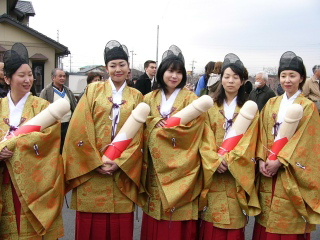
Maidens of the Hounen-sai
(photo from kikuko-nagoya.com)
Festival: Hounen-sai, 15 March. The festival recreates the visit of Takeinadane to Tamahime no mikoto. This is accomplished by carrying a 7-foot wooden penis on the shoulders of men in their yakudoshi “years of danger” (25, 41 or 61). The wooden phallus is enshrined in Tagata Jinja until the following year when a new one is carved and so delivered. Along with the giant, a large number of mini (but only in relation to the aforementioned) phalluses are carried by a procession of shrine maidens. Sake is freely distributed from a cart, before, during and after the procession, thus assuring a well-lubricated journey (I promise that is the last one!). Finally, a “shower” of mochi rice cakes in the form of white and pink balls is rained down on the waiting mass of festival revelers. Receiving a pair is considered an auspicious sign (perhaps of the night to come?).


Ooagata Jinja
Honden of Ooagata Jinja
(photo by Yuta Yanagida via Google +)
Date founded: Founded in the third century B.C. according to shrine tradition.
Address: 3 Aza-Miyayama, Inuyama City, Aichi 485-0004
Tel/Information: 0568-67-1017
How to get there: Take the Meitetsu Komaki line to Gakuden station and walk about 10 minutes.
Enshrined kami: Ooagata okami

Description: The long approach road rises gradually as you near the stone torii of Ooagata Jinja. The honden was built in the Owari zukuri style in 1661 and is designated an Important Cultural Property. The shrine is located in the foothills east of Nagoya in a lovely setting rich in Japanese apricot (ume) trees. There are several shrines on the grounds, the main one dedicated to Oagata omikami. Other sub shrines are dedicated to Tamahime no mikoto (the same kami as enshrined in Tagata Jinja) and Ebisu. This shrine is considered a pair with Tagata Jinja and they share the same festival, the Honen-sai, with Ooagata holding theirs one week before Tagata. Ooagata is considered the female counterpart and several large stones in the shape of a vagina are venerated. 

Sunday, June 16, 2013

Tenkawa Jinja

Tenkawa Jinja (Tenkawa Daibenzaiten Jinja)                      UC
Torii of Tenkawa Jinja
(all photos courtesy of the shrine)
Date founded: Founded by En no Gyoja around 700, according to shrine tradition. Current buildings from 1989.
Address: 107 Tsubonouchi, Tenkawa-mura, Yoshino-gun, Nara 638-0321
Tel/Information: 0747-63-0558 A simple history of the shrine is available in English.
How to get there: Kintetsu Line from Osaka to Shimoichiguchi station.  One hour by Nara Kotsu bus to Tenkawa Jinjamae bus stop (only several busses per day).
Enshrined kami: Ichikishimahime no mikoto and Benzaiten (collectively called Tenkawa Benzaiten)
Prayers offered: Both deities enshrined here are associated with water. Benzaiten is also considered a deity of “all things that flow” and as such, she is prayed to by performers, writers and artists.
Best time to go: Tenkawa has its busiest season in summer with climbers and shugendo practitioners.  The Yoshino mountains offer refreshing relief from the sweltering Japanese summer. Also good to visit in April for the cherry blossoms or November for the fall color.

Haiden with unique isuzu bell
Important physical features: Located in the Yoshino mountains south of Kyoto and Nara, Tenkawa Jinja is located along the Ten no kawa River ("river of heaven") in Tenkawa Village, near the pilgrimage route that leads over the Omine mountain range to Hongu Taisha in Kumano. Mt. Misen, near the northern end of the range where a small shrine is located, is considered the inner sanctuary (Okunoin) of Tenkawa Jinja. The Yoshino-Omine mountains and Tenkawa Village are renown for their natural beauty, especially the area around the nearby Mitarai Ravine, featuring massive rock formations, waterfalls and clear streams. Tenkawa Village encompasses valleys and peaks from 440m to as high as 1,915m above sea level.The main shrine is accessed by several stone stairways that rise up between tall cedars and oaks. The honden of the shrine is in the nagare-zukuri style with chigi and katsuogi. It is raised well above ground level and accessed by broad and steep wooden stairs. The haiden is open sided with a tall pitched roof and a stage for Noh and other performances built into the space. Lanterns are hung under the eaves in front of the honden in a sign of one of the many Buddhist influences. In fact the design is a bit reminiscent of Kibitsu Jinja in Okayama where the haiden is a very interesting, semi-interior space.

Tenkawa reitaisai saitōgoma
Important spiritual features: This area has been closely associated with the shugendo religion that  incorporates elements and beliefs from Shinto, Buddhism (mikkyo), Taoism, and onmyodo (yin-yang), and shugenja were instrumental in the amalgamation of Shinto and Buddhist faith called shinbutsu shugyo. The aim of the shugenja is to obtain great powers for use in spiritual and physical healing, and to achieve Kobo Daishi's ideal of becoming "a Buddha in this body" or in other words, an enlightened being. Ascetic practice in the mountains is the method of achieving this goal. For a more detailed explanation of the sect, please see my book Shinto Shrines; A Guide to the Sacred Sites of Japan's Ancient Religion. The figure considered the epitome if not the founder of shugendo, En no Gyoja (also called En no Ozunu), meditated and had many revelations in the Omine mountains where practitioners continue to walk in his steps even today. He lived in the seventh century and is mentioned in the Shoku Nihongi as living on Mt. Katsuragi well to the north of Yoshino. He is described as a practitioner of magic and as one who controlled demons and had them do his bidding. It is also reported that he was exiled to Izu under some false charge. Only in later centuries was he connected with shugendo and Mt. Kinpu in the Yoshino area, which had become an important center of ascetic training. It is from this later time that the stories of his meeting with Zao Gongen and the Tenkawa Benzaiten arose. While belief in Benzaiten is imported by way of Buddhism and mentioned in the “Golden Light Sutra”, belief in Ichikishimahime no mikoto is native to Japan. This is one of the female kami of Munakata Taisha in Kyushu, children of Susano-o and Amaterasu Omikami, associated with water and especially the protection of shipping. The three kami are also enshrined at Itsukshima Jinja, founded in 593, on the island of Miyajima in Hiroshima. That island also contains a famous Mt. Misen where Kobo Daishi did ascetic practices. Both Ichikishimahime and Benzaiten have been associated with water and this probably led to the deities being identified with each other. However after the Meiji separation of Shinto and Buddhism, Shrines were forced to disassociate from any Buddhist influence so Benzaiten worship was delegated to Buddhist temples (such as  Daiganji temple on Miyajima) and shrines were forced to substitute Ichikishimahime or some other deity associated with water. The fact that this Shinto shrine continues to worship Benzaiten alongside of Ichikishimahime, perhaps reflects the fact that the integrated religion, which was such a strong feature in the lives of the people of these mountains from the sixth to the nineteenth centuries, retains some vestige of that strength. The shrines rituals also include shugendo rites which were outlawed by the Meiji government.
In one respect, it is difficult to speak about the significance of one shrine or temple in this part of Japan, which is known for pilgrimage to multiple sights. Along with the Kumano Sanzan in the south of the Kii Peninsula, Koyasan to the west, and Ise Jingu to the east, this area is now recognized by UNESCO as a World Heritage Site called the “Sacred Sites and Pilgrimage Routes in the Kii Mountain Range.” Strictly speaking, Tenkawa is not included in this group. Instead, Ominesan-ji, a shugendo temple also located in Tenkawa Village on top of Mt. Omine, said to be founded by En no Gyoja and enshrining Zao Gongen, is included. In recent times, Tenkawa Jinja has been a focus of the New Age Movement, as well as musicians and performers from around the world interested in the energy perceived to be emanating from sacred sites such as this.

Description: Tenkawa Jinja (also known as Tenkawa Dai Benzaiten Jinja) is located below Mt Misen with its Okunomiya on top of the mountain. Tenkawa Village is the entrance to Omine range, parts of which are off limits to women. Some distance to the east of this range lies Ise Jingu—the spiritual home of Shinto—and to the west lies Mt. Koya, home of the Shingon sect—one of the principle sects of Japanese Buddhism. Tenkawa lies in the Yoshino-Kumano National Park at the beginning of the Okugakemichi pilgrimage route that all members of the shugendo sect (also called yamabushi) are required to walk as part of their ascetic practice. The route begins in Gojo City in Nara and continues to Shingu City in Wakayama. These men continue to walk the mountains in search of enlightenment and mystical power, as did their famous founder En no Gyoja. Tenkawa (“river of heaven”) worship is deeply rooted in the waters flowing from Mt. Misen, which is associated in Buddhist cosmology with Mt. Sumeru. From this heavenly mountain, water flows in the four directions, sustaining life on the earth below. So too these early mountains have attracted ascetics with the promise of rebirth and enlightenment. In present times, Itsukushima, Chikubushima, and Enoshima are considered the "big three" sites for the worship of Benzaiten, but Tenkawa was long considered to be included in this group. But it does not take a search for enlightenment to enjoy the environment along the Ten no kawa River. A dramatically long and narrow suspension bridge crosses the river, offering spectacular views. Or walk along the beautiful Mitarai valley with its abundant summer greenery, autumn leaves, and lush waterfalls. The current shrine buildings were rebuilt in 1989 and opened with a concert by New Age musician Osamu Kitajima and others. Brian Eno and Haruomi Hosono (of Yellow Magic Orchestra fame) have also given concerts here. Tenkawa has a long association with Noh and plays are performed on a stage near the front of the inner shrine. A popular movie “Tenkawa Densetsu Satsujin Jiken” (The Tenkawa Tradition Murder) from 1991, revolves around the killing of several members of a family of Noh actors, in a struggle over who will succeed as the new head of the tradition. This movie by well-known director Kon Ichikawa, is based on one book of a series of mystery novels featuring detective Asami Mitsuhiko, by author Yasuo Ichida. In this story the Isuzu of Tenkawa is found next to the body of one of the victims.

Festivals: Reitaisai, 16 to 17 July. This festival is famous for its Noh performances and for its Shugendo ceremonies.