Friday, November 23, 2012

Hokkaido Jingu                                                               UC                          
Hokkaido Jingu
(photos courtesy of the shrine)
Date founded: Founded in 1869 as Sapporo Jinja, by an order of the Emperor Meiji. Current buildings from 1978.
Address: 474 Miyagaoka, Chuo-ku, Sapporo-shi Hokkaido 064-0505
Tel/Information: 011-611-0261 Pamphlet in English available at no charge.
How to get there: Take the Tozai Subway line to Maruyama Koen Station, then 15 minutes by foot.  Alternatively, 15 minutes by taxi from JR Sapporo Station.
Enshrined kami: Okunitama no kami, Onamuchi no kami, Sukunahikona no kami and the Emperor Meiji
Prayers offered: Household safety, safety on the roads, protection against harm and opening up the way to good luck.
Best times to go: In early to mid April when 1200 cherry trees are in blossom.

While you're here, any readers who are interested in having a kamidana of their own, or would like to send one to a friend or family member, please check out this post: https://shintoshrinesofjapanblogguide.blogspot.com/2019/06/portable-kamidana-jinja.html
Important physical features: Hokkaido Jingu is located slightly west of the center of Sapporo, and basically within Maruyama Park. This 25 acre park includes a 700 foot hill, and virgin wood featuring giant Elm and cypress trees. It is also home to about 2700 cherry tree and numerous species of birds. The shrine itself is constructed in a modern shinmei zukuri style similar to Miyazaki Jingu and Atsuta Jingu, with unpainted wood, a copper sheet roof shaped in imitation of a thatched roof, many chigi and katsuogi and a very large haiden. The long straight sando and the shrine itself, unusually face northeast. Present buildings date from 1978 after the previous ones were destroyed by fire in 1974.

Important spiritual features: Hokkaido Jingu was originally called Sapporo Jinja and enshrined three deities considered deities of land reclamation. Okuniama, Onamuchi and Sukunahikona are referred to as the kaitaku sanshin (sanjin), and these same three kami were enshrined in shrines in Taiwan and other countries. Originally these deities are related to Susano-o and Izumo. However in the Meiji period, they came to represent an imagined pure and ancient form of Shinto, which the Meiji government was eager to promote. Though originally founded in 1869, the shrine was first built in Sapporo in 1871. In 1964, the spirit of Emperor Meiji was also enshrined and the name was changed to Hokkaido Jingu. The appellation "jingu" is considered by many only to apply to Ise—which is called simply "Jingu". But the Meiji government, anxious to promote a nationwide shrine system with Ise Jingu at the head, and the emperor at the head of all, gave this designation to a number of shrines during the late 1800's. Most, some as Miyazaki Jingu and Atsuta Jingu, had ancient links to the imperial myths of the Kojiki and Nihon shoki. Others, such as Heian Jingu and Meiji Jingu (created in the Taisho Era), did not. This highest designation of kanpei taisha came to encompass sixty seven shrines. Ise stood above and apart from this ranking.

Hokkaido Jingu in the snow
Description: Hokkaido is the newest of Japan’s main islands in terms of its history as a part of the country. In ancient times, numerous expeditions are recorded to the north east as far as the upper reaches of Honshu now known as Tohoku. The various purposes of these expeditions includes increasing the territory under Yamato control and suppressing a people recorded only as emishi. It is probable that these people were actually native Japanese of the jomon era who were increasingly encroached upon by the yayoi immigrants who altered the character of the people and country from about A.D. 200 or earlier. It is likely that they are the ancestors of the Ainu who still inhabit Hokkaido and northern Japan. The island was largely ignored for most of the country’s history, except as an outpost of trade with the northern tribes and later with Russia. This continued until the late-eighteenth century when the increasing fear of encroachment by foreign powers brought a new awareness of nation building to Japan. The Bakufu had already taken over parts of Western Ezo (as Hokkaido was known) in 1798 and Russia launched some raids in 1806. In the 1830’s, the daimyo of the Mita domain asked the Tokugawa to allow him to take over Hokkaido, and begin building defenses against foreign attack (he was denied). After the coming of Admiral Perry in 1853, the Bakfu began to loose control and a coup of sorts by some of the Kyushu and Shikoku domains, moved to restore the Emperor and create a new form of government. When the Tokugawa forces fought a last stand to retain power, they were defeated within a year in what is known as the Boshin War of 1868-69. After a final battle in Tokyo’s Ueno district, Admiral Enomoto Takeaki fled to Ezo with several thousand men, and declared the founding of the Republic of Ezo in Hakodate in December 1868. A government was hastily established and recognized by the French and British. The government occupied the pentagon-shaped compound built by the next-to-last Tokugawa shogun Iemochi. In April 1869 a Japanese force attacked and swiftly ended he short-lived experiment, with Enomoto’s surrender in May 1869. In August of the same year, the island was renamed Hokkaido, with Sapporo as its capital and Hokkaido Jinja was built in 1871. From that time it has been the main shrine of Hokkaido though not its oldest. Today, about 800,000 people visit the shrine during the New Year.

Festivals: Sapporo Festival, 14 to 16 June. The main festival of the shrine, and one of the largest in Hokkaido. Four mikoshi are on parade and events include kagura, Noh, gagaku, a demonstration of martial arts, and others.

Sapporo Snow Festival, 5 to 11 February. Though neither a festival of Hokkaido Jingu, nor even a Shinto festival, this is the biggest event in Hokkaido, with around 400 giant ice sculptures attracting competitors and visitors from all over the world.
Hie Jinja (Akasaka)                                                             C
Haiden of Hie Jinja
(photos courtesy of the shrine)
Date founded: Founded in 1478 by Ota Dokan (1432-86). Currentt buildings from 1958.
Address: 2-10-5 Nagatacho, Chiyoda-ku, Tokyo 100-0014
Tel/Information: 03-3581-2471 Open 5am to 6pm.
How to get there: Take the Chiyoda Subway Line to Akasaka Station or Ginza Line or Marunouchi Line to Akasaka-mitsuke Station, then 8 minutes by foot. Also, take the Tameki-sanno Station on the Namboku and Ginza Lines and then 3 minutes by foot.
Enshrined kami: Oyamakui no kami (also known as Hie no kami and Sanno).
Prayers offered: Good childbirth, protection from harm (yakuyoke), good marriage and others.
Best times to go: When the cherry blossoms are in bloom in early April and for the Sanno Matsuri in June of even-number years.

While you're here, any readers who are interested in having a kamidana of their own, or would like to send one to a friend or family member, please check out this post: https://shintoshrinesofjapanblogguide.blogspot.com/2019/06/portable-kamidana-jinja.html

Important physical features: Akasaka Hie Jinja traces its beginnings to the Kamakura Period (1185-1333) and a man named Edo (unrelated to the name of the town) who formerly owned the land were Edo Castle was later built. A Hie shrine was later built on the grounds of the first Edo castle around 1478 by Ota Dokan who originally built the castle in 1457. The Edo castle compound was later taken over by Tokugawa Ieyasu who rebuilt it. This became the sight of the Imperial Palace when the fourteen-year old Emperor Meiji moved from Kyoto to the newly named Tokyo in 1869. The Ota clan claimed descent from Minamoto Yorimasa and were daimyo aligned with the Ogigayatsu branch of the powerful Uesugi clan, for who the Edo Castle was originally built. It was often the case that when a castle was built, a shrine was built or an existing shrine designated as its guardian shrine. It seems that Ota built both a Tenmangu shrine and a Hie shrine on the castle grounds. Both were later moved with Hie moving slightly southwest of the castle in 1607, ostensibly to allow average citizens to worship there. It burnt down in the Great Meireki fire of 1657 and was located on it’s present spot in 1659, when it was rebuilt at the behest of Tokugawa Ietsuna. The present shrine was rebuilt in 1958 after being destroyed in WWII.
The choice to create a bunrei of Hie—divided from the spirit dwelling in Sannomiya in Kawagoe—meant that this was a shrine in the shinbutsu shugo tradition of Ryobu Shinto established by the Tendai Buddhist sect of Mt. Hiei near Kyoto. Whether or not the original building was in the Hie style is not known but the shrine rebuilt in 1678 was a gongen-zukuri style. Currently the shrine is a variation of the gongen-zukuri style favored by the Tokugawa. The honden is quite small compared to its massive haiden/heiden. The honden has chigi and katsuogi and the entire roof of both buildings is clad in copper sheet. The roof of the haiden is truly impressive in scale, gained by the layering effect of sub-roofs and building wings. There is a very large chidorihafu on the front side but the ridgepole is higher than that of the building. This gives the impression that the building is oriented with the roof ridge running front to back. Two wings with slightly lower ridgepoles extend from the right and left sides of the building. There is a long step canopy in front with a karahafu. A copper clad kairou extends from the right and left and wraps around to form an inner courtyard. There is a 3-bay roumon gate at the center of this, with zuijin guardian figures in the outer bays. This is also of an unusual design with a single level, gable roof with chidorihafu and the kairou creates an additional covered opening to each side of the gate, giving it the impression of being 5-bays wide. A flight of stone steps leads to this gate, at the base of which is the distinctive Sanno torii. The zuijin figures—normally seated, male warriors with bow and arrows, are portrayed here as monkeys—the familiar of Sanno. The entire compound is actually on a small hill and the entire grounds are sloped and stepped. The grounds are surrounded at the base by a stone wall which helps to clearly separate it from the urban thoroughfares that squeeze in around it. There are entrances to the grounds on east (main) south and west (back) sides of the shrine. All have large Sanno torii, distinguished by a roof-like structure above the upper lintel. The south entrance is the newest, sporting a huge torii and a staircase that connects to a bridge over one of the surrounding streets. There are a number of smaller staircases also leading from street level up to the shrine grounds. Interestingly, the west or rear entrance takes you up a steep stair through a “tunnel” of red torii, to a small Inari shrine on the grounds. I say interestingly because it is probably the most photographed spot and many therefore mistakenly take this as the main image of the shrine. The grounds are a small tree-covered oasis, raised above the cold urban surrounding.

Important spiritual features: The kami enshrined at Akasaka Hie is Oyamakui no kami of the Susano-o lineage. The kami is mentioned in the Kojiki as being enshrined at Hiyoshi Taisha (Hie Jinja) on Mt. Hiei, and came to form part of a complex Shinto-Buddhist theology developed by the Tendai monks of Enrakuji. This essentially Buddhist form of Shinto came to be known as Sanno Shinto. The kami was amalgamated with the mountain kami of Hiei and is often represented as a monkey. I go into detail on this belief in the entry for Hiyoshi Taisha in "Shinto Shrines: A Guide to the Sacred Sites of Japan's Ancient Religion." However most strains of Buddhism have now been stripped away other than the influences on the building style, the unusual torii, the statue of “Sanno the Mountain King,” and the name of the shrine’s famous festival the Sanno matsuri.

Description: As the former guardian shrine of Edo Castle, Hie Jinja has a deep connection with the city of Tokyo. Today it is tucked away on a small hill in the midst of the Akasaka district. It sits a short distance behind the National Diet Building, the seat of the Japanese government. It is the home of one of the “Big Three” Tokyo matsuri, which include the Sanja matsuri, and the Kanda matsuri (actually big four if one includes the Fukagawa Festival of Tomioka Hachimangu). Many prints from the Edo period depict the Sanno matsuri and it’s tall floats, topped by various historic and mythical figures. These large festivals—originally inspired by the Gion matsuri of Yasaka Jinja in Kyoto—were known as Tenka matsuri and spread to outlying cities where the tradition is continued in the Kawagoe matsuri, Sawara matsuri, Ome Taisai and many others in the Kanto area. However the forty-five tall floats of Hie were abandoned, apparently due to the construction of overpasses in Tokyo from the Meiji Era on. Today, though sporting only the shrine's mikoshi, the festival still attracts huge crowds. Though the festival is actually held every year, the larger procession of about 500 people, called the Jinkosai, is held in even number years only, alternating with the Kanda matsuri.

Reisai (main festival) of Hie Jinja
Festivals: Sanno Matsuri, 15 June in even number years. A procession of 500 people with the mikoshi of Akasaka Hie Jinja, leave the shrine at 8am and parade around the Imperial Palace, Tokyo Station and other landmark sites, before returning to the shrine at 5pm. The chief priest also enters the Imperial Palace grounds to pray for the well being of the Imperial family, the only shrine permitted this privilege since the Edo era when the shogun still occupied the grounds.

Sunday, November 18, 2012

Dewa Sanzan                                                                 UC
Sanshin gosaiden of Dewa Sanzan
(photos courtesy of the shrine)
Date founded: According to tradition, Dewa Sanzan first became known as a religious center in about 593 when Prince Hachiko (Nojo Taishi), the first-born son of Emperor Sushun (r. 587–92), built shrines on the three mountains (sanzan) of Hagurosan, Mount Gassan, and Yudonosan. The current main shrine building at Hagurosan dates from 1818.
Address: 7 Aza Toge, Toge, Haguro-machi, Tsuruoka-shi, Yamagata 997-0211
Tel/Information: 0235-62-2355. A pamphlet in English is available.           
How to get there: To Hagurosan: JR Uetsu Honsen Line from Niitsu Station in Niigata to Tsuruoka Station. Then take the Shonai-Kotsu Bus for Hagurosan and get off at the Haguro Center to climb to the top. Some buses continue to the top (the last stop) if you wish to avoid the 2,446 steps of the omotesando stairs. Some buses that go to Hagurosan also continue to the Hachigome bus stop on Mount Gassan. A separate bus leaves from Tsuruoka Station bound for Yudonosan. Buses are infrequent (4 per day for Gassan, 3 per day for Yudonosan) so timing, especially on the return, is critical (the bus ride takes about 1.5 hours). Bus schedule also varies by season, with greater frequency in the summer. Gassan and Yudonosan are not accessible in the winter.
Enshrined kami: At Ideha Jinja (on Hagurosan): Ideha no kami and Uga no Mitama no mikoto (identified with Kannon). At Gassan Jinja: Tsukiyomi (Tsukuyomi) no mikoto (identified with Amida Buddha). At Yudonosan Jinja: Oyamatsumi no mikoto, Onamuchi no mikoto, and Sukunahikona no mikoto (identified with Dainichi). (note: The kami of all three mountains are also enshrined at the sanshin gosaiden hall on Mount Haguro.)
Prayers offered: Anything to do with the basic necessities of life, such as food, clothing, and shelter.
Best times to go: Hagurosan is accessible year-round, but Gassan and Yudonosan close during the winter months due to snow. The mountain-climbing season is short, from July to mid-October. The natural surroundings are attractive at any time.

While you're here, any readers who are interested in having a kamidana of their own, or would like to send one to a friend or family member, please check out this post: https://shintoshrinesofjapanblogguide.blogspot.com/2019/06/portable-kamidana-jinja.html
Gojunoto of Dewa Sanzan
Important physical features: The three sacred peaks of Dewa include Hagurosan at about 1,358 feet, Mount Gassan (6,500 feet), and Mount Yudonosan (5,000 feet). The three widely separated mountains have comprised a single sacred landscape since about the seventeenth century, but worship on these mountains is much older. Of the three, Hagurosan is closest to the Sea of Japan, making it a sort of spiritual base station when the heavy winter snows make the other peaks inaccessible. For this reason, of the three peaks it is by far the most frequently visited. The bus from Tsuruoka Station first takes you through the bright red, seventy-four-foot-tall ryobu torii built in 1929, which towers over the road to the shrine. The bus then leaves you in front of the second torii and the single-story zuijinmon gate that acts as the entrance to the entire Dewa Sanzan site. The irimoya-style, cypress bark–covered structure was originally a niomon gate housing Buddhist guardian figures. It was built in the late seventeenth century by the Satake clan, which ruled Dewa Province (a combination of present-day Yamagata and Akita prefectures).
            Through the gate, a red-painted, arched bridge crosses the river Haraigawa, and to its right is the suga no taki waterfall. Historically, pilgrims purified themselves here before beginning the ascent into the mountains’ sacred precincts. Slightly further along, to the left of the path, is a designated National Treasure and the oldest structure at Dewa, the five-story pagoda (gojunoto) of Haguro. It was originally built by Taira no Masakado in 937, and rebuilt by Fujiwara no Ujiie at the behest of Emperor Chokei in 1377. With only a ten-by-ten-foot base and ninety-five-foot height, it is diminutive compared with the likes of the pagodas at Horyuji and Kofukuji, but it is an exquisite example of the early-Muromachi wayo style. The weathered surface and its setting amidst towering cedars, some far older, add to its “organic” appearance. The pagoda somehow managed to survive the Meiji religious repression that devastated the shrine-temple complex on the mountain. It remains a fitting introduction to what was once one of the most important sites of shugendo mountain asceticism in the country.
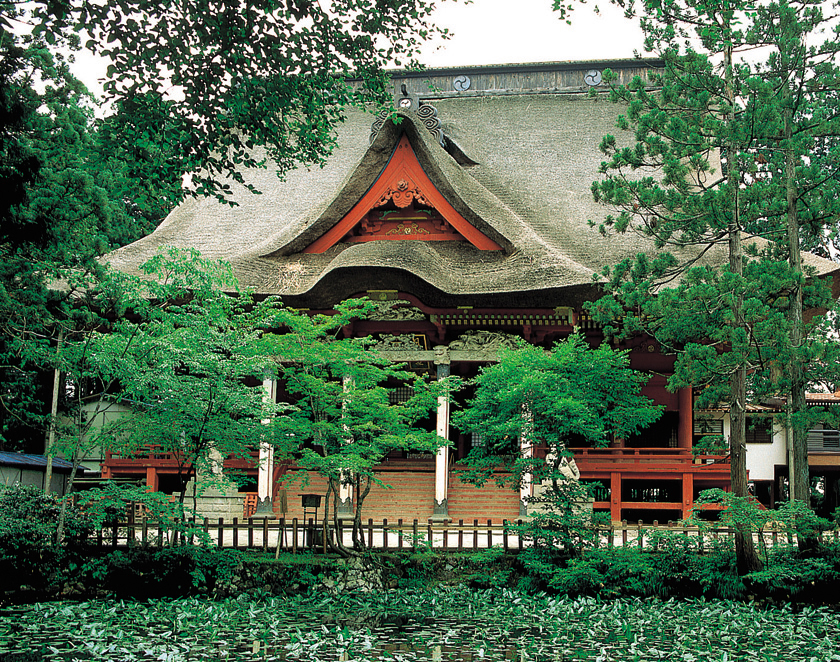
            From there begins the famous set of 2,446 steps to the top of the mountain. There are said to be thirty-three images of lotuses, gourds, and saké cups engraved in the stairs, bringing good luck to those who can find them all. The trek takes about an hour through an old forest of tall pines and Japanese cedars—one of which is thought to be over a thousand years old. To be sure it snows here too, making the stone steps treacherous in winter. At the top is the third torii and the main compound of the shrine. There are about fifteen structures in all, but the main one is the sanshin (or sanjin) gosaiden. It is said to be the largest thatched-roofed shrine in Japan (ninety-two feet tall, eighty feet long, and fifty-six feet deep). The thatch itself is kaya (miscanthus), almost seven feet thick and beautifully packed, curved, and trimmed. The roof is an irimoya-zukuri type, with chidorihafu and a karahafu step canopy. The building is lacquered in red inside and out, except for the four posts supporting the step canopy. Like the ornate sculptures of tigers and dragons under the eave of the karahafu, they are painted white. The building was reconstructed after a fire in 1818 and enshrines the kami of the three mountains, combining both honden and haiden in one gongen-zukuri building.
            Directly in front of the shrine is a pond called mitarashi ike or kagami ike. Hundreds of small bronze mirrors were excavated from the pond, most dating from the Heian and Kamakura periods. As women were not allowed within the precincts, they would send small mirrors as offerings to the kami, which were thrown into the pond. A number of them, together with other treasures, are on display in the shrine museum (open from 8:30 a.m. to 4:30 p.m., for an entry fee of ¥300). Another important structure is the bell house built in 1618, the second-oldest structure at the shrine. The bronze bell that it houses, is inscribed with the date 1275. The bell is 5.5 feet in diameter and 7 feet tall, making it one of the largest in Japan.
            The next of the three peaks is Gassan, which can be reached on foot or by bus from the station in front of Hagurosan (it’s a twelve-mile walk). Even if you decide to take the bus, it leaves you at a place called the “eighth station,” and from there it’s another seven miles uphill to the peak. Most of the walk is a gradual slope, some of it through marshy land, before you arrive at the nakanomiya. From there it is more than two hours to the peak, over some rough hewn stone paths and through fields of tall grass punctuated by alpine plants. There is no great edifice but only a “purification hut” that you must pass through to get to the small shrine at the summit. A priest performs purification (harai) for a ¥500 donation. If the skies are clear, you will be rewarded with a magnificent 360-degree view. If it is rainy or foggy, you might experience something of the desolate and lonely journey undertaken by yamabushi  ascetics, and something of the confrontation with self that is an essential part of their training.
            If you plan to continue on, the next leg of the journey must be made on foot. It’s another two and a half hour walk—but this time all downhill. Mount Yudono is fifteen hundred feet lower than Gassan, and the valley where the shrine is located is another fifteen hundred feet lower still. While most of the walk is down gentle slopes on rocky roads, one part known as the gakko zaka (“moonlight slope”) is a sheer drop of more than seven hundred feet. There are narrow steel ladders and chains to cling to and keep from falling. It gets a little less hairy after that, but is still a long way to the shrine. There is also a roundabout bypass road that you can take, if you don’t feel the need for such Spartan training. You also have the alternative of taking a bus directly from Tsuruoka Station that leaves you at the front entrance to the shrine (the bus would also be the way to return to the city).
            Here, as at Gassan, the shrine is not about architecture but about ritual practice in nature—this time in the form of a huge rock over which hot water gushes (the characters for “Yudono” mean something like “hot water place”). Before entering the area, purification is performed, with shoes and socks removed. The floor around the spring is red from the iron-saturated water, as is the rock—which has grown over the centuries from the accumulated effluent. The proper way to worship is to walk clockwise around and across the rock through the hot water, with hands folded in prayer.

Self-mummified figure of Daijuku Bosatsu
preserved in Yudonosan Dainichibo temple
(photo from temple website:
www.dainichibou.or.jp/english.html)
Important spiritual features: Although the shrines collectively known as Dewa Sanzan enshrine kami and are therefore revered in Shinto, by far the most important spiritual feature is its history as one of the main centers of shugendo mountain asceticism. Shugendo developed out of a combination of esoteric practices of Buddhism, kami worship, Taoism, and yin/yang (onmyodo) beliefs. Its adherents are known as shugenja or yamabushi (“those who lie down in the mountains”). They sought enlightenment by becoming "Buddha in this body" and superhuman powers to control evil spirits through ascetic practice in the mountains. Buddhism was originally able to flourish by supporting and being supported by the ruling class. Most monks were of high birth and led sheltered lives within religious communities. The yamabushi tended to be hijiri (“wandering holy-men”) or gyoja (“those undertaking practice/training”). Such unordained monks and ascetics were originally branded outlaws and often banished for proselytizing among the lower classes. Eventually the practice became widespread but shugenja and many of these men also travelled the country as religious guides (sendatsu) who lead pilgrimages to famous religious sites. The gradually became organized and aligned with major Tendai or Shingon-sect temples, which were responsible for their activities, until they were ultimately required to do so at the beginning of the Edo period. Dewa Sanzan remained unaffiliated with a honzan (main temple of a particular sect) until the mid-seventeenth century.
            Dewa Sanzan claims a heritage that goes back to Prince Hachiko no miko. It is said that he left the capital in 593 after his father was assassinated at the command of Soga no Umako. Though he was the rightful heir he was ousted by Suiko, the first Japanese empress. Legend has it that the prince sailed to the province of Dewa and there came upon a three-legged crow (yatagarasu) that led him to the mountains around Haguro. Given that the Dewa area was well beyond the borders of the fledgling Yamato state in the sixth century, inhabited by a feared people referred to as the Ezo or Emishi, and given that it was a mere forty years after the introduction of Buddhism to Japan, it seems likely that worship here is from a later date. In fact, the yatagarasu is from a story in the Kojiki concerning this bird/kami guiding Emperor Jinmu through Kumano on his way to establish the Yamato state. The symbolism would seem to point to a later date (the Kojiki was written in the early eighth century), and to a connection with Kumano shugendo.
            The first mention of a shrine named Ideha Jinja in Dewa comes from the Engi shiki of 967, possibly the village shrine of Gassan. By the mid-thirteenth century, Hagurosan was already well established as a shrine-temple complex called Hagorosan Jakkoji, and was a major center of shugendo practice. Other centers (such as Omine and Kumano), were affiliated with the Honzan-ha (Tendai) or Tozan-ha (Shingon), but Hagurosan retained its independence. In the mid-seventeenth century, a betto (shrine monk) at Hagurosan named Tenyu reorganized and affiliated the complex with Tendai Buddhism. In this way it became associated to Toeizan (Kaneiji) in Edo. The aim, it seems, was to protect Dewa Sanzan from the manipulations of the rulers of the local domain, but the result was to bring Hagurosan—which also controlled Gassan—into conflict with Yudonosan, which had a strong Shingon heritage. Tenyu’s attempts to bring Yudonosan under Tendai control caused an enduring schism.
            In 1813, a new betto named Kakujun moved to have Jakkoji recognized as the Ideha Jinja mentioned in the Engi shiki. He also wanted the shrine’s legendary founder, Nojo Taishi, to be recognized as Prince Hachiko. Jakkoji was subsequently raised in rank and, although it was not completely clear that Jakkoji was actually Ideha Jinja, the move strengthened a claim to Shinto (i.e. non-Buddhist) roots. This had further consequences when the Meiji separation orders of 1868 forced the removal of all Buddhist elements and the laicization of monks serving the shrine. In any case, by now the point of protecting shugendo worship was moot, as the Meiji government disbanded the religion, forcing members to become either Buddhist or Shinto. However, important rituals of the shugenja were preserved at nearby temples.
            Today, the Akinomine-iri (“autumn peak”), the “mountain-entering ritual” that was the most important of shugendo activities, is continued on a less ambitious scale. Though entering the mountains was once an individual pursuit lasting seventy-five, a hundred, or a thousand days, it is now conducted almost entirely in groups and generally lasts seven days. The Akinomine-iri is a rite of symbolic death and rebirth, which is carried out on Hagurosan from 26 August each year. The mountains are considered to be the place where the kami first descend and where the spirits of the dead reside. As with other forms of shamanism, the yamabushi attains power by visiting the land of the dead and communicating directly with the gods. He carries out self-purifying rituals such as fasting, sleep deprivation, and repeatedly performing misogi water ablutions. In this way he moves from being symbolically dead to being reborn and revitalized. While the original purpose was enlightenment and the attainment of supernatural powers, the yamabushi came to have a two-fold purpose as healers and as guides for pilgrims. In the later role, they acted as providers of lodging and conducted ritual prayers. At Hagurosan, a large community of shugenja resided in the village of Toge at the foot of the mountain, and since the end of World War II, Toge (also called Haguromachi) has once again become the departure point for the Akinomine-iri.

Yamabushi
from "Shinto Shrines:
A Guide to the Sacred Sites
of Japan's Ancient Religion"
Description: The remote mountains of Dewa Sanzan have been the site of ascetic religious practices since ancient times. Along with the Omine Mountains of Wakayama, this area is one of the few places that have managed to protect, however tenuously, the heritage of mountain worship. It is also a shrine with a very strong flavor of Shinto-Buddhist syncretic practice—both physically and spiritually. The people who join the Akinomine-iri these days are from all walks of life, not just those who seek spiritual power. They are also male and female—a twentieth-century innovation. Women were forbidden to enter these mountains in the past, but this is not to say that they did not play an important role. Female figures called miko were and a part of Japanese religious practice from at least the third century and an integral part of the yamabushi’s shamanism. The miko of Hagurosan were generally the wives, mothers, or daughters of shugenja. They performed exorcism, prayers, and healing independently and in conjunction with shugenja and had an important role as vessels for spirit possession.
            The community around Toge is still a place where you can find temple lodgings called shokubo. The lodgings are Spartan by hotel standards, with communal toilets, baths and tatami mat rooms (guests sleep on futons on the floor). The set meals are a variation of shojin ryori (temple food), comprising mostly vegetables and fish. There may also be a requirement to join morning meditation. Many of the shokubo are run by he same shugenja families who have lived here for centuries.
            Two final points of interest related to Dewa Sanzan asceticism are the designation of "three peaks" (sanzan) and the practice by certain monks of self-mummification. One of the greatest authorities on shugendo, Hitoshi Miyake, conjectures that the "three peaks" which are common to all shugendo holy sites, did not refer to actual mountains. He believes the original reference was to the kami of the mountain, the "guide" who represented the local residents who worshipped the kami, and the Buddhist "mountain-opener" who lead by the guide to this holy ground, established the first temple and brought Buddhism to the mountain. It is only later that the symbolic "three mountains" were transposed onto the physical landscape. The second point relates to a temple called Yudosan Dainichibo which lies between Hagurosan and Gassan. It houses the famous mummified figure of Daijuku Bosatsu Shinnyokai-Shonin, who died in 1783 as a result of the singular practice of sokushunbutsu. It was carried out most frequently in the area of Dewa Sanzan and the purpose was to become a “Buddha in this body” to save mankind from suffering. Tradition has it that Kobo Daishi introduced the practice on his return from China in the early Heian period. There were a number of monks at Yudonosan who practiced mokuji—eating only nuts and seeds for many years. Coupled with vigorous ascetic practices, the diet radically cut body fat. In some cases tree bark and roots were also eaten as part of the final preparations. In the next stage only salt and water were taken, and finally, a tea made of the sap of the lacquer tree was drunk. As this is a poisonous material, it caused vomiting and further loss of body fluid. It also made the body resistant to maggots. The monk was then shut in a stone enclosure underground in a lotus or crouching position. A bamboo pole served as an air tube, and a string was attached to a bell on the surface. The monk rang the bell every day until he was dead. Other monks would then seal the tomb for an additional thousand days. When the tomb was opened, if the body was still intact it was a sign that the monk had attained Buddhahood. There are said to be about twenty-eight self-mummified monks from the fourteenth to the nineteenth centuries, of which sixteen or so can be viewed—one being in Yudono Dainichibo temple. The oldest Japanese sokushinbutsu, the monk Kochi who died in 1363, is housed in Saishoji temple in Niigata.

The Flower Festival of Dewa Sanzan
Festival: Annual Festival/Flower Festival, 15 July. The mikoshi of all three shrines are paraded around the kagami ike of Ideha Jinja. Along with the shrines are long poles with flowers grouped at the top, from which long thin poles with more flowers are hung. The pole and flowers represent a rice stalk, and participants try to pull flowers off the stalk as it passes by. Grabbing a flower brings well-being to the family for the coming year. 

Sunday, November 4, 2012

Miyazaki Jingu                                                                           UC

Miyazaki Jingu
(photos courtesy of the shrine)
Date founded: The shrine was founded in the reign of Jimmu Tenno (r.660-585BC) according to shrine tradition.  Current buildings from 1907. 
Address: 2-4-1 Jingu, Miyazaki-shi, Miyazaki 880-0053
Tel/Information: 0985-27-4004
How to get there: Take the JR Nippo Line to Miyazaki Jingu Station, then 5 minutes on foot. 
Enshrined kami: Kamuyamato iwarehiko no sumera mikoto (Jinmu Tenno), Ugayafukiaezu no mikoto (father), and Tamayorihime no mikoto (mother)
Prayers offered: For safe childbirth, protection against misfortune (yakuyoke), and others.
Best times to go: From mid to late April to see the wisteria blossoms, including a rare variety with large white blossoms.  There is also horseback archery (yabusame) on 3 April. The surrounding forest is lovely any time of year.

Important physical features: Miyazaki was a small provincial town until the Meiji period when in 1883 it was chosen by the central government as the capital of the newly created prefecture of Miyazaki in southeastern Kyushu. Prior to this, the area was known as Hyuga since at least the seventh century. The shrine was rebuilt in 1907 on what was believed to be the birth place of Emperor Jimmu, making the shrine an important one in the newly created group of imperial shrines that included the creation of Hokkaido Jingu (1869), Heian Jingu (1895), and Meiji Jingu (1912). Most of these shrines were given the name jingu rather than jinja to show a special connection to the Imperial House, and to link them to an attempted centralization of Shinto focused on Ise Jingu.
         The modern shrine architecture style used here is the work of Ito Chuta, the historian-architect who is also credited with the design of Heian Jingu, Meiji Jingu and many other shrines from the era. For Miyazaki Jingu he created a strictly symmetrical layout of shinmei-zukuri type structures. One of the characteristics of this modern Shinto style is the strict flatness of the roof, made even more so by being surfaced with copper shingles rather than kaya as Ise Jingu. This makes for a much stricter and cooler appearance. The other characteristic is the great length of the roof and width of the structures, as opposed to their shallow depth, and the heavy use of very long chigi along the ridge of every structure from gate to honden. The roof ridge of shinmei-zukuri runs left to right and the entrance is on the non-gable side. The 4-legged gate (shinmon) with a long shinmei style roof with chigi and katsuogi, is followed by a square, open sided “worship place” (haishyo) with the same style roof. This is the point from which people usually make their prayers. A low, open fence that also lines the sando, prevents entry past this point. Beyond this is the large, 7-bay wide heiden with a long roof containing seven katsuogi. Extending from the sides of the heiden, covered corridors connect to two 3x2-bay structures that are placed with the gable facing forward. This gives the building the feel of a shoin style palace from the Heian period. All of these structures have very simple and unadorned round pillars, and the wood has taken on a dark patina over the years. The smaller honden is of the same style, and connected to the heiden by a short roof. Right of the sando just before entering the gate, there is a treasure house also designed by Ito. This semi-European style employs a wall treatment called namakokabe that first became popular on the houses of high-ranking samurai during the Edo period. It became common for storehouses in the western part of the country and involves tiles set diagonally on the wall, with wide gaps in which plaster has been mounded. The tile is usually dark grey like roofing tile and the result is fire and water-resistant.

Important spiritual features: We are told by both the Kojiki and the Nihon shoki that the roots of the imperial line—from the descent of Ninigi no mikoto, to the outset of the third generation in the form of Kamuyamato iwarehiko and his brothers—has its history in the ancient fiefdom of Hyuga (present day Miyazaki). Known as Jimmu Tenno from about the eighth century, the story of this heavenly descendent ultimately founding the kingdom that would become Japan, is central to the Japanese version of divine rule. It will be recalled that the line of heavenly kami continued to marry earthly kami until Jimmu makes his way to Yamato to found the nation, where the ancient texts record a change from the “Divine Age” or “Age of the Kami”, to the age of man. I go into some detail on the founding myths in Shinto Shrines: A Guide to the Sacred Sites of Japan's Ancient Religion." The story of Miyazaki Jingu’s foundation begins in Yamato, where an aged Jimmu (said to have lived for 137 years) is concerned that the Kyushu clans have not yet submitted to his will. Jimmu decides to send his grandson Takeiwatatsu no mikoto to do the job. When he lands back in his ancestral Hyuga, he first stops off at the site of present day Miyazaki Jingu to worship his grandfather, before going on to find a place to settle down and develop the land. The place he finally settles in is Aso and therefore he is enshrined at Aso Jinja in neighboring Kumamoto. He is therefore considered the founder of Kyushu while Jimmu is considered the founder of the nation. While the dates are not known and take place in mythical time (i.e. there is as yet no written or archeological proof of any nation states in Japan at that time), the traditional foundation date of Yamato (and the official founding date of Japan) is given as 660BC. 
         Archeology does tell us a few things, however, which bare some light on the mythology. It is believed that, in fact, the region later known as Hyuga was late in developing compared to other places in Kyushu. This may be partly because it was isolated from the rest of Kyushu and accessible only by sea. It may also be that a hostile group, referred to in the literature as the Kumasa people, resisted influences from the outside, were responsible for the death of Emperor Chuai (r.), and were finally subdued only in the eighth century. It is odd, therefore, that the writers of these eighth century texts should have chosen this region to begin the history of the country. There is even speculation that Jimmu and his followers landed here from another country and, finding an unwelcoming environment, continued on there way to the Kansai—conquering and consolidating kingdoms as they went.  A later date for development in the south is evidenced by the  the kofun burial mounds in this area being of a later date than those in the Kansai. It is also the case that metal work in bronze was rare in southern Kyushu and that commerce and communication ran east-west along the northern shores and on to Yamaguchi in western Honshu, through the Inland Sea and on to the Kansai area. There is also some evidence from skeletal remains that the  new Yayoi immigrants of North Asian origins, moved into the older Jomon locations occupied by people of South Asian origin. It may be that the mythology of the seventh century chronicles and that of Miyazaki Jingu is a reenactment of this displacement in an area of the country that—because of its isolation—was later in experiencing it, and therefore more prominent in the legends that were handed down. An excellent book on the subject is "Himiko and Japan's Elusive Chiefdom of Yamatai" by J. Edward Kidder.

Shan Shan Matsuri
Description: Miyazaki Jingu occupies an area of 64 acres in the heart of the city. The forest that surrounds the shrine reflects the combination of the belief in the sanctity of nature and the efforts of local people who have taken care to preserve the forest known as Jimmu sama.  This includes a 600 year-old rare, white wisteria, with a canopy reaching some 40 feet in one direction. The shrine itself is built entirely of cedar. Like many of the other imperial shrines built from the Meiji to the pre-war period, Miyazaki Jingu was a statement of the “new order” in Shinto, as defined by the government. Unlike some completely new shrines from the era, Miyazaki Jingu had an ancient history and connection to the Imperial House. As I mentioned above, the area comprising present day Miyazaki is central to the account of the first three generations of kami after the decent to earth.  The prefecture therefore boasts many ancient shrines dedicated to those involved in the mythical birth of Japan.

Yabusame at Miyazaki Jingu
Festivals: Miyazaki Jingu Taisai, first weekend after 26 October.  Also called "Shan Shan" Matsuri, from the sound made by the bells decorating the horses in the procession of 1000 people in period costume.

Sunday, October 14, 2012

Hakone Jinja                                                                          UC
Entrance gate of Hakone Jinja
(photos courtesy of the shrine)
Date founded: Founded in 757 according to shrine tradition. Current buildings from 1936.
Address: 80-1 Moto-hakone, Hakone-machi, Ashigara-Shimo-gun, Kanagawa-ken 250-0522
Tel/Information: 0460-83-7123
How to get there: JR Tokaido Line or Shinkansen, or Odaku Line to Odawara station. Take the bus from the east exit to Moto-hakone or Hakone-machi bus stop (about 60 minutes), then 10 minutes by foot.
Enshrined kami: Hakone Okami (said to be Ninigi no mikoto, Konohanasakuya hime, and Hikohohodemi no mikoto).
Prayers offered: Safety on the road.
Best time to go: The natural environment of the area and of nearby Lake Ashi is enjoyable all year.

Important physical features: Hakone Jinja is located by the shores of Lake Ashi (Ashinoko), a lake with a circumference of approximately 12 miles that formed in the caldera of Mt. Hakone about 3000 years ago. It is also over 2,300 feet above sea level and the blue waters of the lake are said to be very pure. Seen from above, the area around Lake Ashi looks like the collapsed twin of Mt. Fuji, directly to its west. to put it in the context of Chinese divination (Onmyodo), some consider that this area has Yin energies that balance the Yang energy of Mt. Fuji. The yotsuashi torii of Hakone Jinja stands in the lake, a few meters from the shore. Though constructed as recently as 1952 in commemoration of the peace treaty that ended World War II, it lends a magnificent effect to the feeling of the shrine and to the lake itself. On a good day, the combination of Mt. Fuji makes a beautiful sight as it looms up clearly behind the lake and torii. That shore and the entire area is heavily forested with old cedars and the area behind the shrine contains a very special forest composed entirely of Stewartia monadelpha (himeshara), the only such forest in the country. At one end of this forest lies the tomb of the monk called Mangan (circa 720-816) who founded the shrine. The shrine itself is built in the gogan-zukuri style that combines the honden, heiden, and haidan, under one roof. It is also a style that often contains elaborate carvings and polychrome finishes.

Important spiritual features: Mangan was an ascetic monk named for the 10,000 volumes (man-gan) of the Hokokyo sutra that, as legend has it, he read. He was well known as one of the early monks who “converted” Shinto gods into Buddhist avatars. Perhaps the most famous of these was the kami of Tado Taisha in Ise. It is recorded in the engi of Tado jinguji of 788 that Mangan Zenji (Mangan Shonin) built a small temple near the shrine and prayed to Amida Buddha there. In 763 he received an oracle that the kami Tado wanted to renounce his position as a Shinto kami and help mankind rather than cause pestilence and death (as it was believed the kami was responsible for at the time). Mangan built a hall to worship him as Tado Daibosatsu near the shrine. The Shoku Nihongi records 763 as a year of plagues and food shortages. This was one way in which Buddhism made inroads into the lives of the people, by converting malevolent kami and turning them into the protectors of the Buddhist law. Perhaps the more significance part of this story comes in the year 780 when the imperial court acknowledged the jinguji officially recognizing its four privately-ordained monks, whose purpose was the reading of Buddhist sutras for the redemption of the kami. It is related that he lived in the Hakone area for three years and encountered the yamabushi who worshipped on the mountains there. Although at an earlier date (757) than the jinguji of Tado, it is said that he either built Hakone Jinja (called Kanto Sochinju Hakone Daigongen or Hakone Sanjo at that time and Hakone Gongen in later ages) after an oracle in a dream, or that he combined three existing shrines on the surrounding high peaks (Mt. Hakone, Mt. Kami and Mt. Komagadake) into one. Worship of "three-peaks" is a particular characteristic of shugendo religious practices. In either case, this shrine has deep roots in mountain asceticism and the rise of shinbutsu shugyo—the synthesis of both religions.

The torii of Hakone Jinja on Lake Ashi
Description: Mt. Hakone was a center of Shugendo and mountain asceticism from at least the eighth century. Though it does not appear in the Engishiki, this is not unusual for shrines with strong Buddhist associations (Iwashimizu Hachimangu is also omitted). Situated at the southeastern shore of Lake Ashi, Hakone Jinja is one of the oldest shrines in the eastern part of the country. Until the Meiji era forced separation of Shinto and Buddhism, it was referred to as Hakone Sansho Gongen a name which clearly reflects it's three enshrined kami. The kami were identified with Miroku bosatsu, Sho kannon bosatsu and Monju bosatsu respectively. The shrine has been well visited ever since a shortcut connecting the West and East of the county was constructed through Hakone in the Heian period. At this time, a son of the reigning emperor was appointed chief priest which is said to be the origin of the shrines's three-chrisanthemum crest. As the Tokaido road that connects Kyoto and Tokyo became increasingly traveled in the sixteenth century, Hakone was an important post town. During the Edo period, in the year 1619, a major checkpoint for maintaining control of the comings and goings of the people, was built near the shrine, adding again to the numbers who stayed in Hakone and visited the shrine to pray for safety on their journey (the Hakone Check Point has been recreated and is open to the general public). This is also the reason the kami of Hakone Jinja is known for protecting travelers.
            Legend has it that Sakanoue no Tamuramaro (758-811), who was the first to be given the title seitai shogun (barbarian subduing generalissimo), was sent by Emperor Kanmu to bring the eastern districts of Mutsu and Dewa (present day Aomori, Yamagata and Akita prefectures) under control. On his way, it is said that he stopped to pray at Hakone Jinja for divine protection. So too the azuma kagami (a record of the Kamakura shogunate) records that Minamoto no Yoritomo, the leader of the Genji clan, found refuge at the shrine after retreating from his loosing battle with the Taira clan at Mt. Ishibashi. Having thus prayed for the protection of the kami, he went on to defeat the Taira and take control of the country. In the modern period a number of prime ministers and politicians have frequented this shrine to ask for divine intercession with the heady problems of state and—one would assume—help with reelection.
            The shrine was once destroyed in Hideyoshi Toyotomi’s siege of Odawara. It was rebuilt by Tokugawa Ieyasu and patronized by later Tokugawa shoguns. But due to repeated fires and the destruction of the separation of Shinto and Buddhism durine the Meiji Era, there is not much left of the physical history of this shrine, other than an early Heian period sculpture of Mangan and some other artifacts, which are on view at the Treasure House (admission 300 yen). But Hakone has always been about the beautiful and refreshing environment. Jagged mountains such as Mt. Komagatake (4,450 feet-where the motomiya of the shrine is located), Mt. Kintoki (3,980 feet), and Mt. Kami (4,717 feet), a crystal blue lake, and dense forests, and some excellent views of Mt Fuji, have made Hakone not only a sacred space, but also given it the stamp of a leisure and vacation spot. As such, there are many attractions in the area, not to mention many old shrines such as Miyagino Suwa Jinja, and temples such as Saijouji and Sounji. There is also a “seven lucky gods” pilgrimage beginning with Shugenji (Daitokuten), then Hakone Jinja (Ebisu), Kofukuin (Hotei), Hongenji (Jurojin), Komagata Jinja (Bishamonten), Lake Ajigaike Benten Jinja (Benzaiten), and Sanno Jinja (Fukurokuju). Despite all this, the mention of the name "Hakone" in Japan probably brings to mind—first and foremost—its famous hot springs, many of which are in the immediate area of Hakone Jinja. Also within the immediate area lie an old stone-paved section of the Tokaido Highway called the Hakone Hachi Ri, and a famous row of over 400 cedars between Hakone-machi and Moto Hakone, planted in the early seventeenth century. There is also an area to the northeast of the shrine which is famous for its twenty-six old stone sculptures of the Buddha, and stone monuments (called “castles”), many containing ancient graves. Having been a vacation spot for so long, there are any number and type of transportation including two ropeways (Komegatake and Hakone), cable railway (Komagatake and Sounzan), and a number of cruise ships with various courses around Lake Ashi.

Festival: Lake Ashi Summer Festival Week, 31 July to 7 Aug. Taiko drumming and other events including floating lanterns on the lake and a display of fireworks on the thirty-first.

Sunday, September 30, 2012


Atsuta Jingu                                                                             UC
Gate to the grounds of the honden of Atsuta Jingu
(photo by Gnsin via Wikipedia)
Date founded: Founded on the death of Yamatotakeru no mikoto in a.d. 113 according to shrine tradition. The shrine was founded to enshrine the sacred sword Kusanagi no tsurugi, one of the three Imperial Regalia. The current honden is from 1955.
Address: 1-1-1 Jingu, Atsuta-ku, Nagoya-shi, Aichi 456-8585
Tel/Information: 052-671-4151. A brief history of the shrine in English is available.
How to get there: Meitetsu Railway to Jingumae Station, then three minutes by foot. JR Tokaido Line to Atsuta Station, then about eight minutes by foot. Meijo Subway Line to Jingu-Nishi Station or Tenma-cho Station (closer to the main entrance), then about five minutes by foot.
Enshrined kami: Atsuta no Okami, identified as Amaterasu omikami as embodied in the sacred sword Kusanagi no tsurugi (one of the three sacred treasures of the imperial throne). Also, in the aidono,  Amaterasu Omikami; Susano-o no mikoto; Yamatotakeru no mikoto; and Takeinadane no mikoto and Miyasuhime no mikoto (ancestors of the Owari clan).
Prayers offered: Pray for bountiful crops, family harmony, and safety on the roadways.
Best time to go: Although located in the heart of the city of Nagoya, a lovely wooded area surrounds the shrine. The grounds are at their best in spring and summer.

Important physical features: Although it may not be viewed, the truly important physical feature of Atsuta Jingu is the sacred sword of Susano-o, of Amaterasu, and of Yamatotakeru called the Kusanagi no tsurugi. In terms of the shrine itself, Atsuta Jingu is a modern version of shinmei-zukuri. This notion of remaking the shrine from its former style into shinmei-zukuri arose in the Meiji era, and the work was first completed in 1893. The Meiji government created a group of ninety-seven national shrines in 1871 known as kanpeisha (imperial shrines), of which twenty-nine were initially given the highest rank of kanpei taisha. Atsuta Jingu became one of these shrines, which also included many of the nijunisha (or twenty-two shrines receiving offerings from the Imperial House during the Heian period). The name Jingu, previously reserved for Ise, was given to some older shrines (such as Atsuta and Miyazaki) and some newly created ones (such as Heian and Hokkaido) starting at about that time. Atsuta Jingu was heavily damaged during World War II and restored between1955–66 to its present condition. Some of the buildings of the naiku at Ise were brought here after that shrine’s renewal in 1953. Some differences with Ise Jingu include a roof surfaced in copper rather than thatch (although prewar pictures show it with a cedar shingle roofing) but curved to retain a thatched-roof silhouette; columns supported by foundation stones, rather than being planted directly in the ground; no twenty-year rebuilding regimen; and no leaving a “dormant” site when the old shrine is dismantled. Another difference with Ise is the two smaller shrines for the yaoyorozu deities of the East and West within the courtyard occupied by the honden, arranged on either side of it. Ise has two treasure houses to the left and right rear (which is thought to reflect the original layout). Though shrines rather than treasure houses, the in-line arrangement at Atusta reflects the layout that prevailed at Ise before the Meiji period.
            Like many other shrines, Atsuta has suffered numerous fires and been rebuilt many times in its long history. Unlike many other shrines, it has the distinction of having been rebuilt or repaired at different times by Japan’s “big three shoguns,” Oda Nobunaga, Toyotomi Hideyoshi and Tokugawa Ieyasu. A document from 1841 inventories and details the buildings, and a drawing shows the layout as it was in the early seventeenth century. By that time, the shrine had a multiple fence/multiple gate structure and the layout was similar to what it is today. According to tradition, the shrine had four gates when a structure was first erected (said to be in 684) and the south gate (kaizomon) had a tablet written by Kobo Daishi–the founder of the Shingon sect of Buddhism. The Western gate was supposed to have had a tablet written by Emperor Tenmu. Of particular interest is the treasure house, holding about four thousand objects including garments, furniture and utensils, mirrors, and bugaku masks—many designated Important Cultural Properties. The Kusanagi no tsurugi is not on display, but a large number of important swords and daggers are. The treasure house is open from 9 a.m. to 4:30 p.m. Admission is 300 yen for adults.

Important spiritual features: Of the kami enshrined at Atsuta Jingu, all but one are related to the sacred sword called the Kusanagi no tsurugi (“herb-mowing sword” or “grass-cutting sword”), which is also known as the Atsuta no okami. The unrelated kami, Takeinadane no mikoto, is a native agricultural deity of the Owari area (present-day Aichi). Both this deity and his younger sister, Miyasuhime no mikoto, are considered to be ancestral deities of the Owari clan, and the shrine is believed to have originally been a family shrine. The Owari were said to have descended from Hoakari no mikoto, one of Ninigi no mikoto's three sons. It seems that the Owari and illustrious Urabe were branches of the same family.
           The principle kami of Atsuta Jingu, though, is said to be Amaterasu omikami in the form of the sacred sword. This is one of the three imperial regalia (sanshu no shinki) that were entrusted to the heavenly grandson Ninigi when he descended to rule Japan. The Kojiki and Nihon shoki record that when Ninigi was sent to rule, Amaterasu gave him, in addition to the sword (also known as Ama no murakumo no tsurugi [“sword of the gathering clouds of heaven”]), the jewel known as Yasakani no magatama and the mirror known as Yatanokagami. When she gave these three objects to him, she said explicitly about the mirror “… when thou look upon this mirror, let it be as though looking on me.” Though no such explicit statement is made about the sword or jewel, it is taken for granted that they all embody the spirit of Amaterasu. It is also taken for granted that the sword is the same one that Susano-o pulled from the tail of the eight-headed serpent (yamata no orochi), which he slew in the land of Izumo. Though the Kojiki and Nihon shoki offer different versions of this legend, it is generally accepted that Susano-o sent the sword to Amaterasu as a sort of recompense for past wrongdoings (though how the sword got into the dragon, and therefore its true origin, is not stated). As I mentioned above, the sword is also called by two different names (Ama no murakamo and Kusanagi) in different versions of the story in the Nihon shoki. The sword was passed down to Ninigi, and the next we hear of it is when it turns up in the imperial palace during the reign of Emperor Sujin (r. 97–30 b.c.), along with the mirror. Here we are told that the emperor feared the power of the deities embodied in them and wanted the mirror and sword removed to another place. The Kogoshu of 807 tells us they were first removed to a place called Kasanui in Yamato, and then later to Ise (the legendary founding of Ise Jingu). The Kogoshu also records that duplicates were made at that time and that these were the sacred regalia (only two, not three as in later times, presented to the new emperor upon ascending the throne.
           Then, much later, during the reign of Emperor Keiko (a.d. 71–131), we are told that the emperor sent his fourteenth son, Yamatotakeru no mikoto, on a mission to conquer the East. On his way, he stopped at Ise Jingu and was given the sword by his aunt, the high-priestess of the shrine, in order to protect him on his journey. During this crusade, his enemies trick him several times into traps, and on several occasions the magic of the sword saves him. On one such occasion, he is surrounded by fire, but the sword cuts down all the grass around him, allowing him to escape. By some accounts, from this point the sword is called Kusanagi no tsurugi (“grass-cutting sword”), though it was already referred to in this way by in some earlier accounts. The story continues that Yamatotakeru’s mission is successful and that he goes on to marry Miyasuhime from the province of Owari. But for some unknown reason, he leaves the sword with his wife before embarking on his last mission. This time he has heard of a wrathful deity savaging the country around Mount Ibuki and goes out to meet him. Before he can return home to her, he is killed (or dies from illness), and his wife enshrines the sword first in her home and later in Atsuta, in present-day Nagoya.
            Yamatotakeru is an extremely interesting figure in Japanese mytho-history. He is the sort of tragic hero and even scapegoat figure so prized in Japan. In other words, the hero who "dies trying" is often more a hero than the one who succeeds. We are told that the prince, who is credited with conquering numerous enemies and expanding the area of the dynasty, was feared by his own father and kept at arms length battling enemies along the boarders. Though denied the throne he is said to be the father of Emperor Chuai whose consort was Jingu Kogo and whose son was Emperor Ojin. Although Atsuta Jingu was probably dedicated to him, he is not the principal kami enshrined here. I will devote further study to this fascinating figure and post it to this blog in the future.
            As the sword is also considered the body (shintai) of Amaterasu, some consider Atsuta Jingu the second most important shrine after Ise. As early as a.d. 807, Inbe no Hironari, the compiler of the Kogoshu, laments that, “Atsuta Shrine has not enjoyed any of the special privileges due its divine nature” (the Inbe were the clan responsible for court ritual, along with the Nakatomi, and the Kogoshu is considered one of the most important historical documents of Shinto). This may have been because the sword was not considered the shintai of Amaterasu, but was misunderstood to be the shintai of Yamatotakeru or another deity. It was also once thought that the other kami enshrined at Atsuta was not Amaterasu but Inada hime, wife of Susano-o. Such beliefs may have been held until the Meiji era, when recognition of Amaterasu omikami would have justified the change of rebuilding in the shinmei style and raising its rank to kanpeitaisha. However it is important to note that the combination of jewel, sword and mirror has been found in a jar-burial from the early Yayoi period at the Yoshitake-Takagi site in Fukuoka, Kyushu. It seems that these symbols may have been the possessions of at least one local chieftain, signifying his status as leader. While beads, bronze mirrors and bronze swords have been uncovered in numerous sites throughout Japan from earliest times, at some point this combination was appropriated to become the symbols of rulership solely of the imperial line.
            Another story associated with the sword is that it was stolen by a priest from Silla during the reign of Emperor Tenji. The priest was apparently captured but the sword was returned to the imperial palace rather than to the shrine. Then, during the reign of Emperor Tenmu (who waged war against his brother Tenji's son to claim the throne), the emperor was taken ill and a divination determined that this was due to the presence of the sword in the palace (curiously reminiscent of Emperor Sujin's motivation for sending it away), and it was then returned to the shrine.
            As with most shrines in Japan, Atsuta was once amalgamated with Buddhism and had a temple for worshipping the kami (jinguji), built during the reign of Emperor Ninmyo (833–50) that enshrined Yakushi Nyorai, a pagoda, and other Buddhist structures, but these were destroyed during the Meiji period. Today, Atsuta Jingu stands at the head of about two thousand branch shrines throughout Japan.

Description: The name Atsuta Jinja is said to come from an incident at the shrine’s founding. The site contained a maple tree that spontaneously burst into flame and started a fire in the adjacent rice field. The water in the rice field turned hot instead of extinguishing the flame. This is how it got its name, which translates literally to “hot rice-field shrine.” A long, broad road (sando) leads from south to north and passes through a grove of trees and under three large wooden torii before reaching the shrine. The grounds are quite large, at about fifty acres, including ancient camphor trees around a thousand years old. The grounds are also home to forty-four sub-shrines and attendant buildings. The shrine claims to receive over nine million visitors annually, with about 2,350,000 of these visiting during the first three days of the New Year.

Festival: Rei Sai (Main Festival), 5 June. Commemorates the day that offerings (heihaku) were first sent to the shrine from the imperial household. The ceremony to greet the imperial messenger is held between 10 and 11 a.m. Demonstrations of tea ceremony, Noh theater, flower arrangement, and kendo are held throughout the day. After dark, tall clusters of lanterns (makiwara) and rows of food stalls make the summer evenings pleasant and festive.

Monday, September 17, 2012


Amano Iwato Jinja                                                 UC
Amano Iwata Jinja
(photos courtesy of the shrine)
Date Founded: The age of the cave called Amano Iwato is undocumented. Shrine foundation dates are also unclear. Present buildings date from 1955 and 1985 respectively.
Address: 1073-1 Iwato, Takachiho-cho, Nishiusugi gun, Miyazaki 882-1621         
Tel/Information: 0982-74-8239. English translation of the myth of Amano Iwato is available.
How to get there: The directions are the same as for Takachiho Jinja until you get to Takachiho. Then take the bus from the Takachiho Bus Center (about 6 miles). Buses depart hourly (6 buses per day) to Amano Iwato Jinja-mae bus stop.
Enshrined kami: Amaterasu omikami in the western shrine, Ame no iwayado in the eastern shrine.
Prayers offered: Pray for good luck and happiness.
Best times to go: For the kagura traditional dance festivals, May 2nd to 3rd, and September 21st to 23rd. Also for the cherry blossoms in April and autumn colors in November.

A view from inside Amano Yasugawara cave
Important physical features: This shrine (and indeed, neighboring Takachiho Jinja) is located in a difficult place for the casual tourist to reach. It is in the mountains northeast of Miyazaki City. It can only be reached by bus (from Takachiko) or by car. The most important physical property of the shrine is of course the cave, Amano Iwato (“Heavenly Rock Dwelling”), where Amaterasu Omikami hid herself away, and the Amano Yasugawara cave, where the “eight-million myriad deities” (yaoyarozu) gathered along the “Tranquil River of Heaven” to plan a way to lure her back out. I go into some detail on the myth in "Shinto Shrines: A Guide to the Sacred Sites of Japan's Ancient Religion." The main, western-shrine (nishi hongu) is on the west bank of the Iwato River (a branch of the Gokase River) but Amano Iwato is on the right bank, behind the eastern-shrine (higashi hongu). You cannot approach Amano Iwato but you can look toward it (you can’t actually see it through the trees) from a deck inside the nishi hongu shrine (and taking photos is discouraged). The cave acts as the goshintai, the body of the enshrined spirit. The buildings here are new, both being from the late 90’s. The nishi hongu is entered through a 3-bay gate built in a sort of modern shinmei zukuri style, with a large gabled-roof covered in copper tiles. There are also chigi and katsuogi on this roof and the entrance is under the eaves on the non-gable side. From the right and left side of the gate, a tall, unpainted tamagaki fence surrounds the inner grounds. Passing through this gate brings you to the courtyard in front of the haiden. The haiden looks like a double of the gate except that it is raised a few steps above ground level, and it is deeper. To the right and left of the main 3-bay structure are two additional shrines, also with large gabled-roofs, this time with the entrance on the gabled side. This is a rather unique arrangement that seems to be related to the form of Takachiho Jinja—the architecture of which is older. These shrines are connected to covered corridors that emanate from the left and right sides of the haiden. To the left of the shrine is a kaguraden, built in an older style with a gabled roof with chidorihafu false dormer and karahafu in a small step-canopy.
The higashi hongu is approached up a long flight of stairs through a lovely wood. There is a series of three torii but no gate. The haiden is similar to the nishi hongu but smaller and simpler. It has an open grill front and the back is open, giving a view of the honden. The honden is shinmei zukuri surrounded by a tamagaki fence and you can walk around the entire shrine. Although Amano Iwato itself is off limits, you can freely approach the Amano Yasugawara cave—in fact, you can walk right into it. A path leads from the nishi hongu along the Iwato River and across a narrow, arched bridge. The banks along the river and the approach to the cave are strewn with an incredible number of small stone cairns or alters (iwasaka) erected by worshippers. A torii stands in front of the cave and a paved-stone path leads underneath it. Inside the cave itself is a small shrine for making devotions. The whole effect of grand nature and primitive stone offerings is one of mysterious beauty, punctuated by the sound of the swift-flowing stream.

Important spiritual features: Amano Iwato is considered by some to be the site of one of the most important stories of the Imperial Shinto epic of how the ancestor of the emperor came to be recognized as the primary kami in the heavens. I describe this legend in the introductory notes to "Shinto Shrines: A Guide to the Sacred Sites of Japan's Ancient Religion" so I will only give an abbreviated version here. The destructive rampaging of Amaterasu's brother, Susano-o, drove the sun kami to hide herself in the cave called Amano Iwato and thus deprive the world of her light. So distressing was her absence that all the kami got together to discuss how to lure her out. The myth is central because it points to Amaterasu as "first among equals" and shows the support of all the other kami for her position (vs that of Susano-o's). The myth is thus often considered a device used by the Yamato clans and their allies of the seventh or eighth century, to legitimize their rule. The plot to lure Amaterasu out of Amano Iwato, involved a number of kami who were later sent to earth with Amaterasu’s grandson Ninigi, and are considered the ancestors of some of the most powerful clans of the new state. Of course there is little in the way of evidence to connect the Amano Iwato of “the plain of high-heaven” to the Amano Iwato of modern day Miyazaki Prefecture. It is simply taken on faith. At first glance, for example, it may seem somewhat incongruous that the “heavenly rock-cave” is located only several miles from Mt. Takachiho, the place where the grandson of Amaterasu descended from heaven to rule the world. However the concept of heaven above, earth below, and hell below that does not necessary apply in the strict physical sense; especially in Shinto, where the land of the dead and the land of spirits, both good and bad, are often considered to be ever-present right alongside man.

Description: Amano Iwato has become the de facto representation of the “heavenly rock-cave” though what most visitors are able to see is actually the Amano Yasugawara cave where the kami gathered to discuss strategy. In conjunction with the nearby town of Takachiho, Amano Iwato Jinja helps to bring these myths to life with nightly performances of kagura—dances that recount these ancient legends. The kagura is said to originate with the dance of Ame no uzume, who performed in front of Amano Iwato in order to lure Amaterasu back into the world. The dance succeeded in making the “eight-million myriad kami” roar with laughter, prompting Amaterasu to take a peak at the unexpected uproar. Ame no uzume was considered the ancestor of the Sarume clan who were charged with carrying on the ritual ceremony of dancing for the pleasure of the gods. So it is that most large to medium size shrines have kaguraden on there grounds where performances are held on festival days. One might find such local accoutrements as the Disyneyesque statue of Tajiarao—the “hand-power” kami who pulled away the stone covering the cave (or pulled Amaterasu out of the cave depending on the version)—or Ame no uzume revolving on an overturned bucket a bit out of character to the solemnity one would expect of such a divine location. But maybe this too is designed to evoke a mighty guffaw, just like the one that shook the heavens and made the sun reappear, all those eons ago.

Festivals: Kagura Festival, 3 November. All-day kagura, featuring a range of performances.